

Five, Four Hundred, Ten
Five. Then four hundred. Now, reportedly, fewer than ten. That is the arithmetic of Microsoft in Nairobi, and before I give you this week’s version, let me introduce you to the five.
Many years ago, in the last century, I used to swing by a quiet, swanky office on 3rd Ngong Avenue to see my pal Msitu then an early MS staffer.
Microsoft had a handful of people there, not more than five.
They say pesa haipendi kelele, and that office was the proof.
You whispered even to say hi. The lady at reception looked at me the way we now look at a rider we suspect took three drumsticks from our KFC 20-piecer.
The reception had real wood panelling that would make gypsum envious.
They were very posh, and they were very few.
This week, a Fintech Association of Kenya newsletter brought me back to Microsoft. Reports suggest fewer than ten could remain from roughly four hundred employees at its Nairobi Africa Development Centre. Microsoft has not confirmed those totals and says it will continue operating in Kenya. The old sales office and today’s engineering centre are different operations, but consider the journey: Kenyans who once sold the technology ended up helping build it.
Then comes the meeting about your job.
School fees are due. The mortgage has not heard about restructuring. Your relatives still introduce you as “our daughter at Microsoft,” and you are wondering when to tell them. Allow people to grieve that before arriving with a motivational quote. But look at what these engineers carry with them.
You return the laptop. You do not return what you learnt.
They built for users across the world, and those users are still there. So are other businesses needing those skills.
The office may shrink. The market need not.
Our diaspora readers know a lot about finding the next opening. Behind the dollars arriving home are unfamiliar winters and shifts worked while Kenya sleeps. Kenyans abroad sent home US$5.04 billion in 2025; CBK’s revised projection for 2026 was US$5.1 billion.
Some of these engineers may find opportunities abroad and add to that pot. Others could serve global clients from Nairobi.
I have always said that one of Kenya’s biggest exports is our people.
A salary paid abroad still finishes a house in Kitengela and educates a child in Nakuru.
Our diaspora friends may know somebody recruiting. Somebody helped you find your feet once. You remember what that meant.
At the receiving end, though, there is another problem. Have you looked carefully at your thousand bob lately?
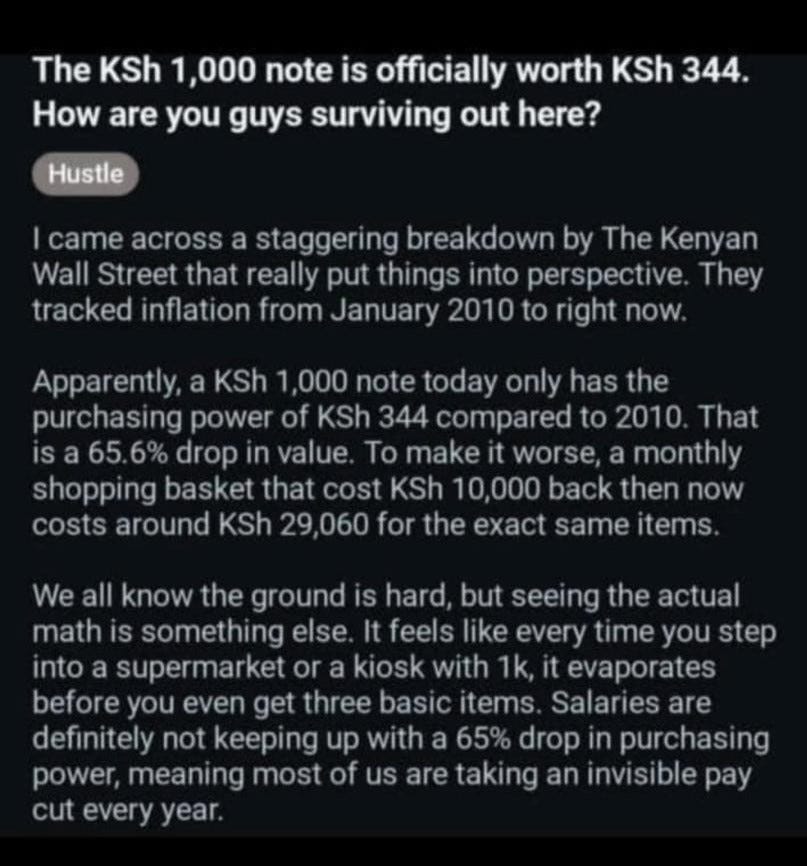
One Thousand Bob. Explain Yourself.
There was a time you could send someone a thousand bob and sit back feeling you had made a difference. These days you send it and immediately explain yourself.
“Bro, niko down. Kula kidogo kwanza. I’ll sort you out properly on Friday.”
Even your generosity now comes with an instalment plan.
A graphic doing the rounds put today’s thousand shillings at KSh 344 in January 2010 money. Updating to September brings it to about KSh 342. Put the other way, what KSh 1,000 bought then would require roughly KSh 2,900 now, using the overall consumer price index.
The note still says one thousand. You still send it with the seriousness of one thousand. Then it reaches the shops and starts behaving like three hundred and forty-two.
You have sent your mum the same amount for years, faithfully. In your mind, you have maintained your support. At her end, she has been deciding what to leave out. Then she asks for more, and you mutter that everything has become money with these people.
Which people? The woman buying cooking oil?
Now carry that thousand bob into Monday’s meeting. Sales are up. Did you sell more, or charge more because your suppliers charged you more? A bigger revenue number can do a convincing impression of progress.
Count the money. Then ask what it can still buy.
And before telling a young employee that you survived on less in 2010, price the life you expect them to maintain today. Their rent is not being collected in nostalgia.

JAJUOK PARTNERS WITH NIKE
Meanwhile, where some of my closest friends come from, night running is not a sport.
Mention Jojuogi (pl. singular JahJuok) and the Luo and Luhya contingents begin exchanging looks. Those from elsewhere move closer.
Naked? At night? Doing what, exactly?
In the fireside tales, a runner roams after dark, sometimes smeared in ash, banging on tin roofs, throwing sand at houses and sprinting away when chased.
The thrill is your fright. The urge, people say, runs in families.
Before my friends start explaining their relatives, let us proceed.
The village had its answers. One reported trap was an open doorway covered with a sheet. The runner arrives to kick the door, meets thin air and tumbles inside. Other tales end with livestock changing hands before dawn so that a name stays unshouted at sunrise.
Then there is the “Kanyaga Meko” tale in the research: the lady of the house stepping on the cooking stones to restrain the restless husband. Other versions bring bedroom sanctions into it. Our friends from western Kenya, which versions did you hear? Settle the details in the comments.
Some households apparently had their own athletics committee.
Now Nike has organised night running.
Properly.
Registration, coaches, race numbers, photographers.
The London leg of its After Dark Tour was scheduled for Saturday, October 17: a women’s 10K from Silverworks Island, through the Royal Docks, including London City Airport’s runway. Sold out, according to the event page.
Sold out. People wanted to run at night so badly that some could not get a place.
Back home, nobody asks whether you registered. They ask whether you locked the kitchen door.
Imagine the village proposal. Organised night running. Silence. Participants will wear numbers for identification. Now the cattle dip chairman is interested. There will also be photographs. Several comfortable people begin asking about data protection and royalties. In the stories we grew up hearing, being identified was the punishment. Nike has made it the souvenir.
Nike says last year’s tour attracted more than 50,000 women, one in three a first-time racer. Consider the woman postponing her first run. Too dark after work. Nobody to go with. Worried about being last. Create a gathering where beginners belong, and you can see why places go.
Sometimes you only need make the invite funkier.
Still, that Kenyan application form: previous night-running experience?
Answer carefully. It may affect your starting position.
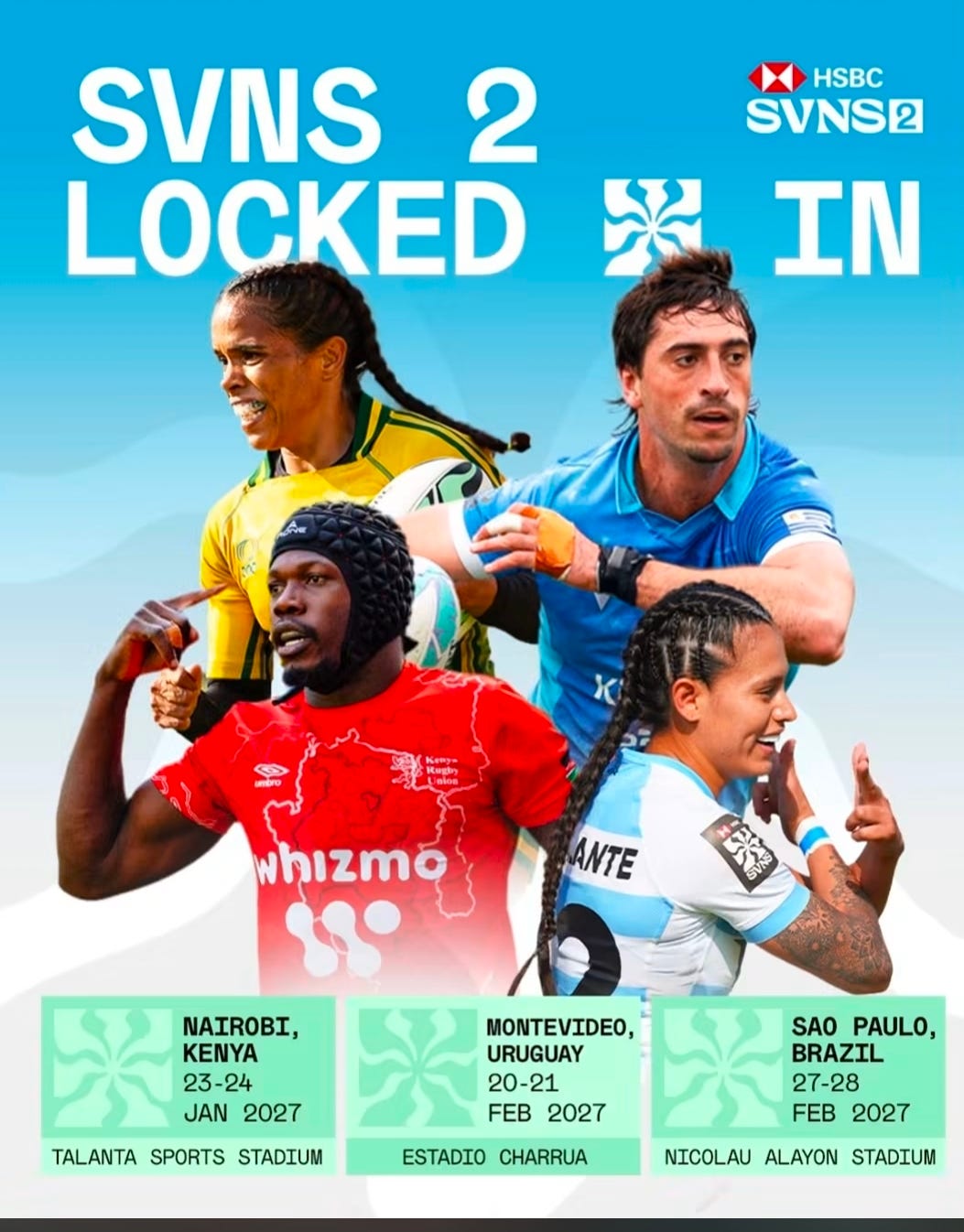
A Hundred and Twenty Kilos of Waiting
And while Nike finds a runway for its runners, some Kenyan rugby players would settle for a fixture.
Congratulations to KRU on securing Nairobi’s HSBC SVNS 2 hosting for January 23–24, 2027, at Talanta Sports Stadium. Visiting teams, supporters, business and a home crowd deserve applause, alongside Shujaa and the Lionesses’ Safari Sevens successes.
Then Irish Olympian Harry McNulty observed, via SportyFM Kenya: “There’s more rugby sevens being played in Kenya than there is in Ireland.”
We popped our collars and said nani kama sisi.
Until we checked the fifteens rankings. Ireland third. Kenya thirty-sixth.
Now the collar is tight.
E.F. Aligura on Facebook recently counted 454 days without official Simbas rugby, dating from the July 19, 2025, Algeria match. Today, 456 days have elapsed since that game.
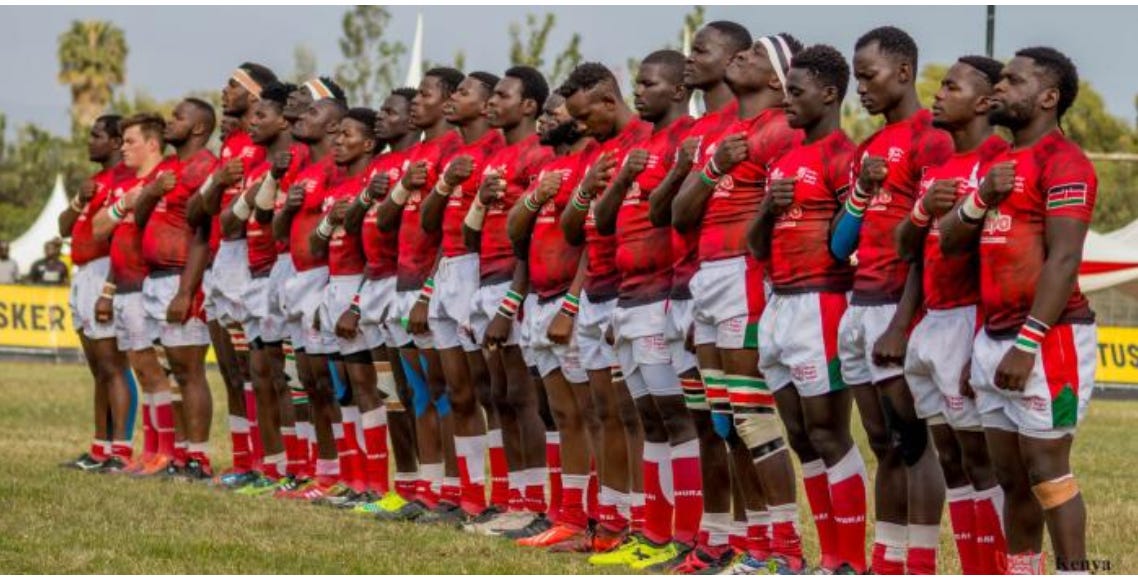
Think of the fellow waiting. Six foot five, a hundred and twenty kilos. Or the stocky man built like a village wrestler, gifted at moving another unwilling human backwards. There is intelligence in that work. Years learning where to put a shoulder.
You cannot send them all to Sevens.
They train, play for clubs, hope for selection. Another birthday arrives while the national jersey waits in a cupboard.
A rugby career has an expiry date.
International appearances can matter overseas. Sevens participation must meet the destination’s endorsement rules; SVNS 2 is no automatic work permit. Scotland’s XVs rules provide an example: for countries ranked twenty-fifth or below, one route requires three ranking Tests in twenty-four months and ten career internationals.
How does our hooker, prop or 2nd row build recent caps without fixtures?
KRU, please use your relationships for reciprocal tours and affordable Tests. Arrange development games too, distinguishing which award caps.
Give players minutes, footage and introductions to recruiters.
Four hundred engineers facing uncertainty. A mother stretching the same 1k from her son. A player getting older while waiting to represent his country.
“Kula kidogo kwanza” can get someone through Friday. What happens on Monday?Somewhere in your address book is a person who could help someone earn again. A former colleague recruiting. A customer needing software. A rugby contact who could arrange a match.
Before forwarding another motivational quote, try that number.
I remember when Microsoft had five people in that quiet office. Look how much Kenyan ability we have seen since. Surely we can find more work for it.
And if you see us running after dark, ask whether Nike is involved before joining.
And if the whole world is truly in debt…..who do we owe?
I’ll leave you with the wise words of Yama on X

Same Forest. Different Monkeys.
Mubarikiwe. Jah Bless.
Go with song in the words of Ochieng’ Wuod Ojola
The Nike Night Run was done for Women specifically, and some dudes still signed up 🤦🏿
Dar es Salaam has an amazing Night Run open to all, and Nairobi has been having them at Parklands Sports Club. We don't trust Nairobi Roads that much yet 😂😂😂