

🎵 Human Nature
Early this week, I received a message from a close relative. One of those WhatsApp messages that you almost ignore… then leaves you staring at the wall.
She had just picked up her son from swimming. You know the routine. Towel. Bag. Water bottle. Half-finished homework. The child is talking. The parent is listening… but also tired.
They get home. She sits down for that quiet 1-on-1.
“How was your day?”
“What did you learn today?”
“Show me your homework.”
Then the boy pauses. Looks at her. And asks:
“Mama… when were you born?”
She laughs it off. “Forty-something years ago.” (Actual number withheld to protect the innocent.)
He does the math. “Ah… so around 1986?” She nods noting the compliment.
Then he leans back… completely serious… and says:
“So… how was it being a slave?”
Silence. The kind that is not empty… but full.
“He wasn’t insulting her. He was auditing her life.”
Her son was not being rude. He was being logical. From his perspective, the equation didn’t add up.
One job.
Multiple hustles.
Loyalty. Stability. Delayed rewards.
In his world?
You’re too busy.
So when he looked at her life… he didn’t see sacrifice.
He saw constraint.
“That question didn’t hurt. It exposed.”
Which is exactly where Dr. Eliza Filby enters the story.
🎵 Man in the Mirror

In a conversation with Simon Sinek on A Bit of Optimism, Dr. Filby reframes the entire debate.
Not: “What’s wrong with this generation?”
But: “What world did we hand them?”
She is 44.
Millennial.
A mother.
A historian studying generational inheritance.
Her central point is simple, generations don’t just behave differently. They respond to different systems.
After 2008, those systems shifted. Job security weakened. Housing moved out of reach. Cost of living outpaced income. One structure quietly replaced another:
the “Bank of Mum and Dad.”
Which means for many young people today, the biggest financial variable is not effort. It is access.
So when that boy asked his mother that question… he wasn’t comparing effort. He was comparing systems.
“And systems don’t reward effort. They reward position.”
🎵 They Don’t Care About Us
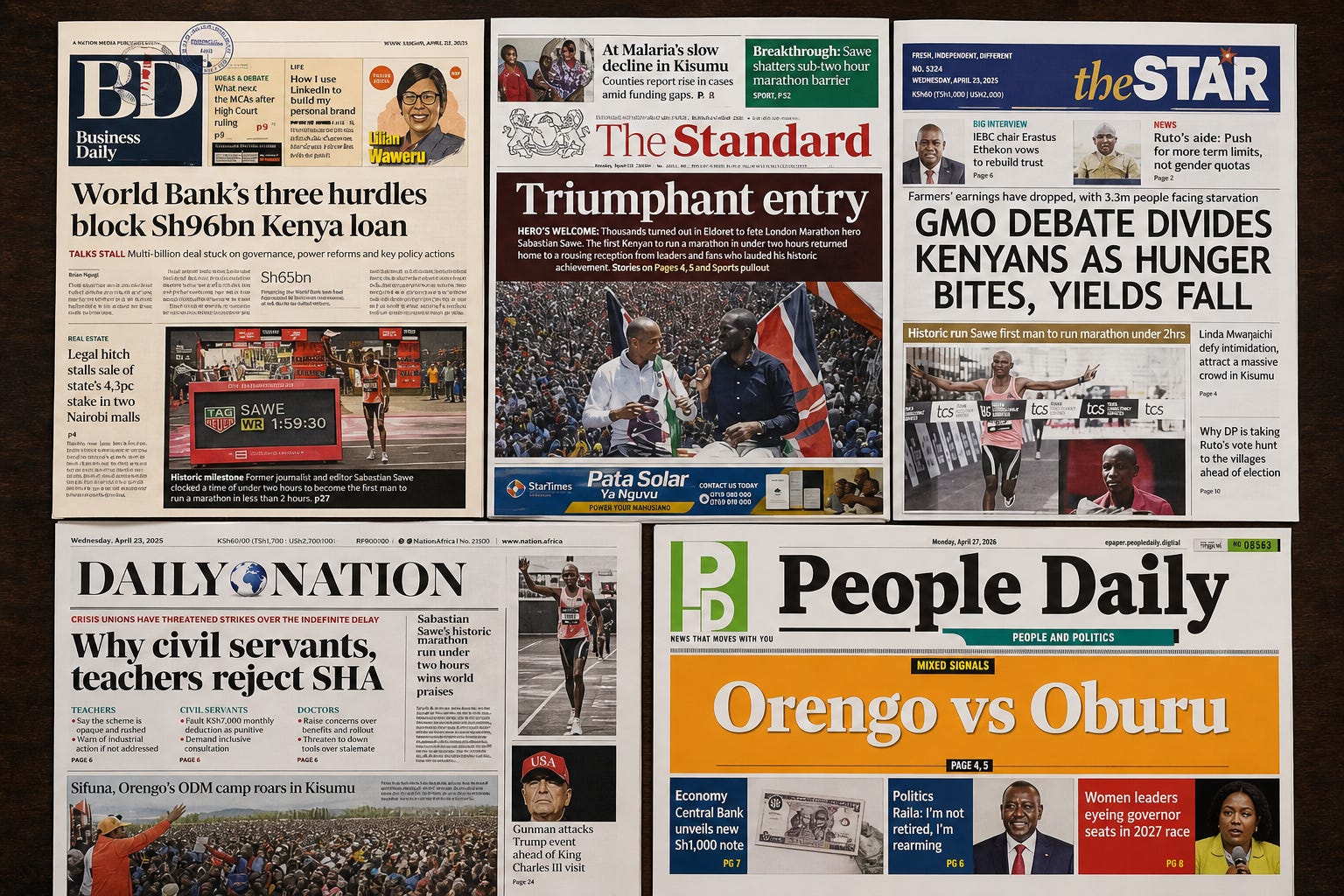
That same week, something else happened. Not quietly. But strangely… almost invisibly. Former journalist and editor Wallace Kantai put out a comparison of front pages; side by side, a simple visual audit of what was being prioritised.
What filled the space? Politics. Infighting. Recycled narratives.
What didn’t?
Excellence.
Front pages are not neutral. They are curated. They tell you what a system chooses to preserve. And in that moment, the signal was clear: we say we value achievement, but we consistently reward visibility.
“We don’t ignore excellence. We just don’t prioritise it.”
Then comes the proof. Sabastian Sawe ran a full marathon in under two hours. A barrier that has defined human endurance for decades — broken. In any structured system, that becomes a national moment. But the outcome didn’t match the input. Locally, muted.
Internationally, amplified.
That gap is not emotional.
It is structural.
People inherit systems that tell them what matters.
If the system rewards noise, noise dominates.
Sawe’s run had no shortcuts, no drama, no daily controversy — just performance.
The dominant narratives operate differently.
Built for reaction. Rewarding conflict. Easier to consume, easier to monetise.(or so they think)
When the system shifts, behaviour follows.
“If performance spoke louder than noise, our headlines would look very different.”
🎵 Smooth Criminal

Once you see the pattern, you can’t unsee it.
It shows up where decisions are made, in the market, in the boardroom, in the moment a customer quietly switches and says nothing.
For years, Nike didn’t just sell running shoes.
They sold belief.
Walk into a Nike store and the first thing you encounter is not the product, it is the story, the identity, the version of yourself you are being invited into.
Run clubs. Community. Belonging.
And for a long time, it worked, because when stakes are low,
People buy alignment.
Then something shifted. Not in the marketing. In the outcome.
At the London Marathon, athletes chose what delivered.
Adidas didn’t out-market Nike.
They out-performed them.
The requirement was not identity,it was efficiency, fatigue reduction, execution under pressure.
Every business, every salesperson, every brand operates across two systems:
the shop window and the outcome.
The shop window attracts.
The outcome answers the only question that matters when stakes rise:
What happens if I choose you?
When stakes are low, identity leads.
When stakes are high, performance decides.
Emotion opens the door. Performance closes the deal. Talent travels.
But value is captured by structure.
“Brand builds attention. Results close arguments.”
“Most people don’t change brands because of marketing.
They change when the outcome disappoints.”
🎵 Dirty Diana
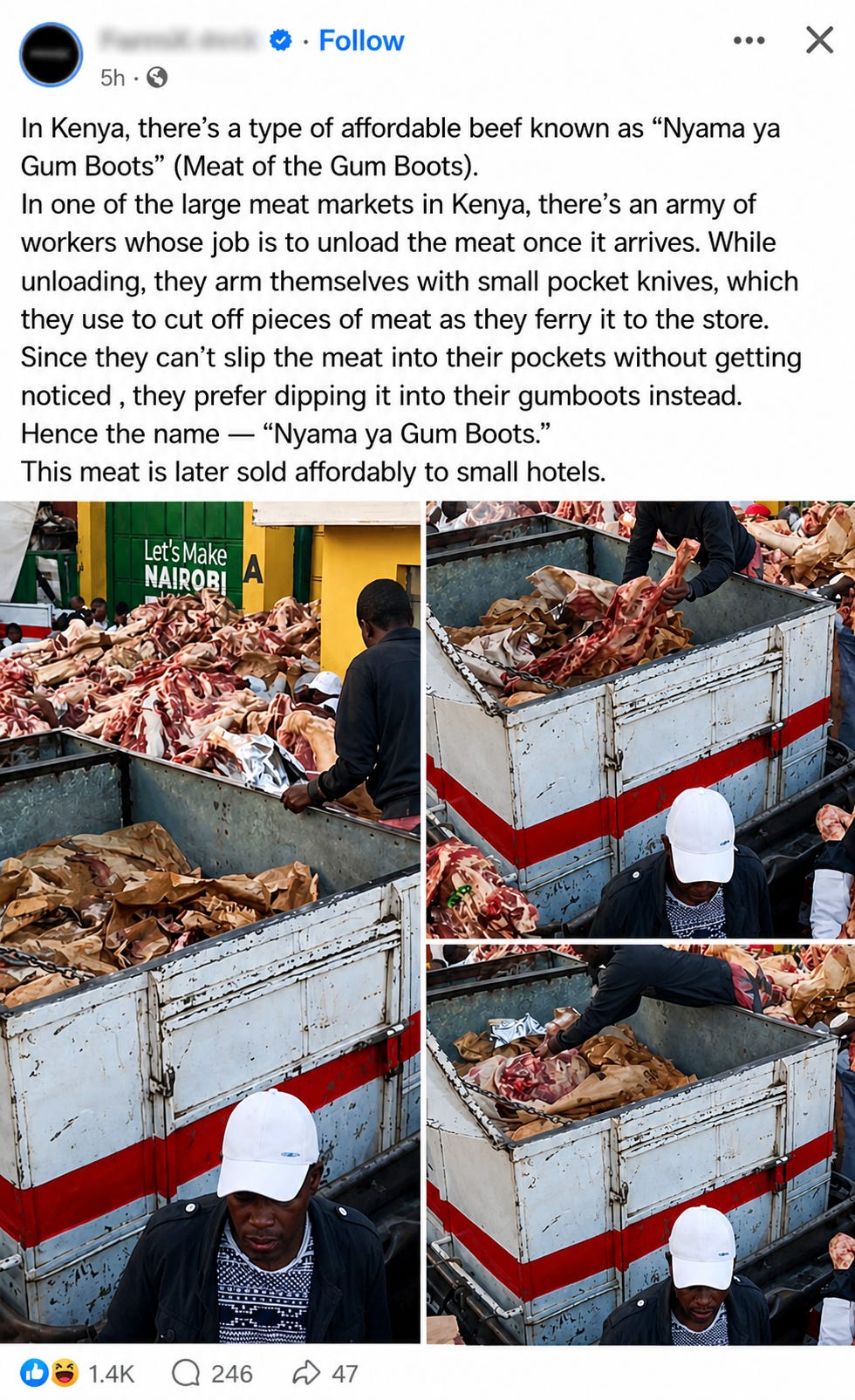
That same shift shows up on the ground.
This week, I was at my local gathering my thoughts waiting for my half kilo maji maji. Same place. Same routine.
Then my phone buzzed: a story about “nyama ya gumboots.”
Meat that didn’t follow the expected system.
I looked up. Walked to the proprietor.
A Frenchman from Nyahururu.
His name of course Monsieur (throw in Kinuthia, Njuguna or Kungu for local context)
Asked one question: Is your supply clean? He answered immediately.
Credible source. Showed me pictures. Ranch-based.
Transaction complete. Pricing understood.
But the decision had already changed.
In a system optimised for affordability and speed, the trade-offs are not always visible at the point of purchase.
Lower price often means a different process.
Faster access often means fewer checks.
Sometimes the cost has just been moved out of sight.
Two systems. Same market. Different outcomes.
🎵 Thriller

A bunch of billionaires had been watching.
Not tweeting. Not commenting. Watching.
Put up 3 million dollars.
Then the Rugby Premier League showed up.
Not with nostalgia,
Not with development narratives,
With hard cash.
Six franchises. Broadcast deals. Ten-year partnerships.
A format built for television, sponsors, and return.
This wasn’t a tournament. It was a system.
From Kenya’s sevens setup — Patrick Odongo, Samuel Asati, Nygel Amaitsa, John Okoth to Delhi Redz. Kevin Wekesa to Hyderabad Heroes.
Then the ladies showed up.
Not as dates. Not as “flower girls”.
Part of the main act.
Gracie Okulu to Mumbai Dreamers.
Sheila Chajira to Chennai Bulls.
That is not random selection. That is pattern recognition.
Top players earning $15,000 for a two-week window. Others $2,500.
Same player. Different system. Different outcome.
Kenya produces talent, that is not in question.
What changes is what happens after the talent appears.
One system supports.
Another packages.
We don’t inherit opportunity.
We inherit what happens to opportunity.
Because left alone, talent is just potential.
It is structure that turns potential into a contract, a number, a career.
“We don’t lack talent. We lack systems that can afford it.”
🎵 Remember the Time
Now the pattern is clear. A child’s question sounds disrespectful but is analytical. A historian explains that behaviour follows structure. A front page reveals what we choose to preserve. A marathon exposes the gap between effort and recognition. A market shifts from identity to performance. A league monetises what another system develops.
Same inputs. Different structures. Different outputs.
A good friend and colleague named after a murima Forest once told me….
“Talent gets you noticed. Structure gets you paid.”
“Let’s stop calling it patience.”
“Some of us weren’t waiting. We were stuck.”
But let me be honest, and I say this as someone who has sat in enough boardrooms, enough sales meetings, enough performance reviews to know how this goes.
We love to celebrate Kenyan talent. We put it on billboards.
We clap at galas. We repost the wins.
But the moment it is time to build the structure that retains that talent, compensates it fairly, creates a system around it, we go quiet.
Suddenly there’s no budget. Suddenly it’s not the right time.
Suddenly someone is asking why we need to professionalise something that has “always worked this way.”
Patrick Odongo didn’t need Delhi Redz to tell him he was talented.
He already knew.
What the league gave him was a structure that agreed with him financially.
There is a difference between being celebrated and being valued.
One costs nothing. The other requires commitment.
“Talent doesn’t change. The cheque does.”
And this is where I want to push you — not the system, not the billionaires.
You.
Are you operating in a system that matches your output?
“Or are you loyal to a structure that has never planned to reward you?”
Or have you been so conditioned by loyalty and delayed reward that you’ve started calling constraint sacrifice?
That boy wasn’t wrong. He just had better information.
The question isn’t whether he’s right.
The question is what you’re going to do now that you’ve heard it.
Before I leave you, I want to come back to her. Not as a data point.
As a woman who drove to a swimming pool after a long day, sat in traffic with a wet towel on the back seat, asked her son the right questions — and got one she wasn’t ready for.
She could have been defensive. Instead she sat with it. Let it land.
Sent a WhatsApp and said: can you believe this child?
That is the quiet intelligence of a mother who knows her son is not her enemy — he is her mirror.
“And mirrors don’t lie. They just arrive earlier for some generations.”
What he reflected back was not a failure of effort. It was a question about whether it was time — not for regret, but for revision.
There are a lot of women and men like her in this forest.
Running homes and businesses and teams, carrying the weight of both the old system and the new one.
They don’t get the billboards.
They get the quiet 1-on-1 at the kitchen table.
Sometimes, if they’re lucky, a question sharp enough to make them think.
That is worth more than any front page.
Which brings us back to the beginning. That question:
“Was it like being a slave?”
It wasn’t disrespect. It was analysis.
A different generation, looking at a different system.
So the real question becomes: what system are you operating in… and what happens when someone chooses you?
Because in the end, its not the story that carries the weight.
Its the outcome.
Pull up a seat — wherever you’re reading this from.
Nairobi. London. Cape Fear.
What does this look like on your side?
Share it. Tag your squad. Comment.
Same forest. Different monkeys.
Mubarikiwe. Jah Bless.
Go with song.🎵