
For years we were told leadership was about strategy.
Targets. Budgets. Market share. Efficiency.
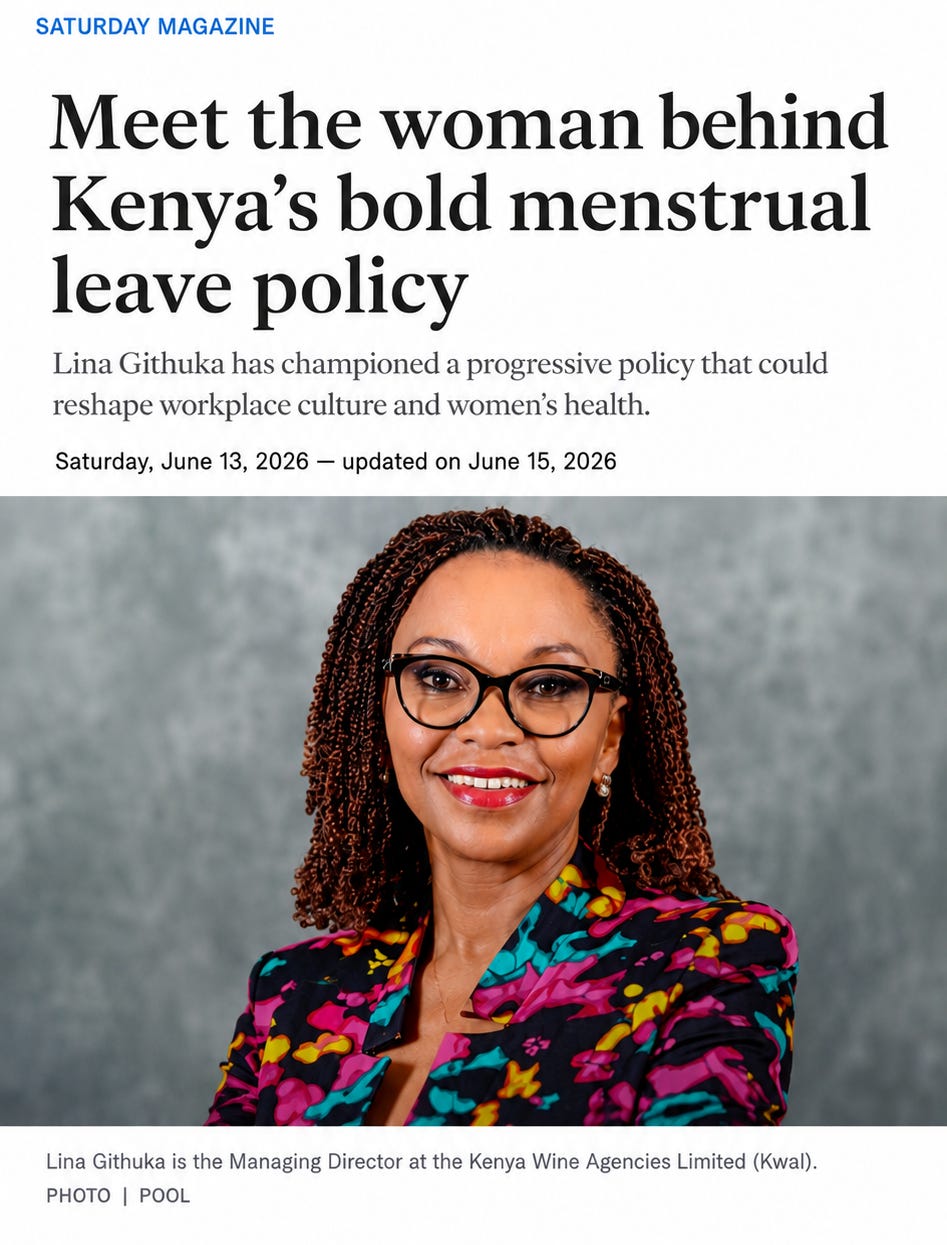
Then along came Lina Githuka and started redesigning “the humanity around the people in the business” — and the things that matter to them.
A week ago, the Managing Director of Kenya Wine Agencies Limited found herself at the centre of a national conversation after introducing a Feminine Leave Policy granting female employees one paid day off every month for menstruation, perimenopause and menopause.
No doctor’s note.
No complicated forms.
No interrogation.
Just trust.
Predictably, the internet did what the internet always does. Some praised the move as progressive leadership. Others asked whether businesses could afford it. A few wondered whether employers would quietly start preferring male hires. And somewhere between the applause and the outrage, most people missed the more interesting story.
The policy did not arrive out of nowhere. Ms. Githuka joined KWAL in November 2018 — the first woman, the first local, to hold the Managing Director’s seat in a company founded in 1969. She did not arrive chasing headlines.
In 2019, lactation rooms.
In 2021, maternity leave expanded from three months to four, extended to cover adoption, surrogacy and stillbirth.
Paternity leave grew to three weeks.
Forty-five women managers graduated through the Ela Lidera Women in Leadership Programme.
Then came Bro-Code — a safe space for male employees to talk about mental health, pressure and the things men carry without saying. One policy after another. One uncomfortable question after another.
The menstrual leave announcement was simply the latest chapter in a six-year project most people never noticed. Her own words on the productivity question were simple: “Most women show up to work even when they are in discomfort. But are they really being productive? We know the answer to that.” That is not HR language.
That is someone who has been paying attention.
A CASE FOR MAN FLU

For years, Man Flu has been the punchline of women’s WhatsApp groups.
A man develops a mild cold and suddenly behaves like a Victorian aristocrat on his deathbed.
He requests green tea.
He demands sympathy.
Women roll their eyes.
Children continue avoiding him.
The internet laughs. Case closed. Or so we thought.
Because somewhere between the memes and the mockery, scientists decided to actually investigate. What they found was awkward for everyone. Stanford University research published in the Proceedings of the National Academy of Sciences found that men with higher testosterone produce significantly weaker antibody responses to flu vaccines than women.
A study tracking flu-related deaths from 1997 to 2007 found that men died at higher rates than women across multiple age groups — regardless of underlying conditions. The same estrogen that drives monthly menstrual discomfort appears to strengthen immune response against respiratory infections.
The same testosterone that exempts men from that monthly cycle appears to leave them more vulnerable when a flu virus arrives.
Biology gives. Biology takes.
Women carry burdens men never experience. Men carry burdens women never experience. The mistake — in workplaces, in families, in relationships — begins when either side assumes the other’s burden is imaginary.
Because once you start paying attention to invisible burdens, you begin to notice them everywhere.
THE PAYCHECK THAT FUNDS THE PRISON

An old colleague once told me he hated his job.
Not the occasional Monday morning complaint.
Real hatred.
The kind that follows you home and sits on your chest at three in the morning when sleep refuses to come.
Five years later, he still hated his job.
His boss hadn’t changed. The culture hadn’t changed. The politics hadn’t changed.
The only thing that had changed was his commissions and bonuses.
Somewhere along the way the paycheck became too valuable to question. The mortgage got bigger. The car got better. School fees arrived. One day he woke up and discovered something uncomfortable — he had built a prison around himself, one upgrade at a time.
We measure success using almost entirely external indicators.
The title. The office. The car. The promotion.
Yet the people who know us best are running a completely different calculation.
Are you present?
Are you becoming kinder or harder?
Do you still laugh at the things that used to make you laugh?
There is a difference between building a career and building a life.
Tools, left unchecked, become masters.
The prison is not constructed overnight.
It is built one obligation, one rationalisation, one upgrade at a time.
And the most dangerous part?
You don’t notice until the door is already locked.
Which brings us to Tim Payne.
THE LEAST FAMOUS FOOTBALLER AT THE WORLD CUP
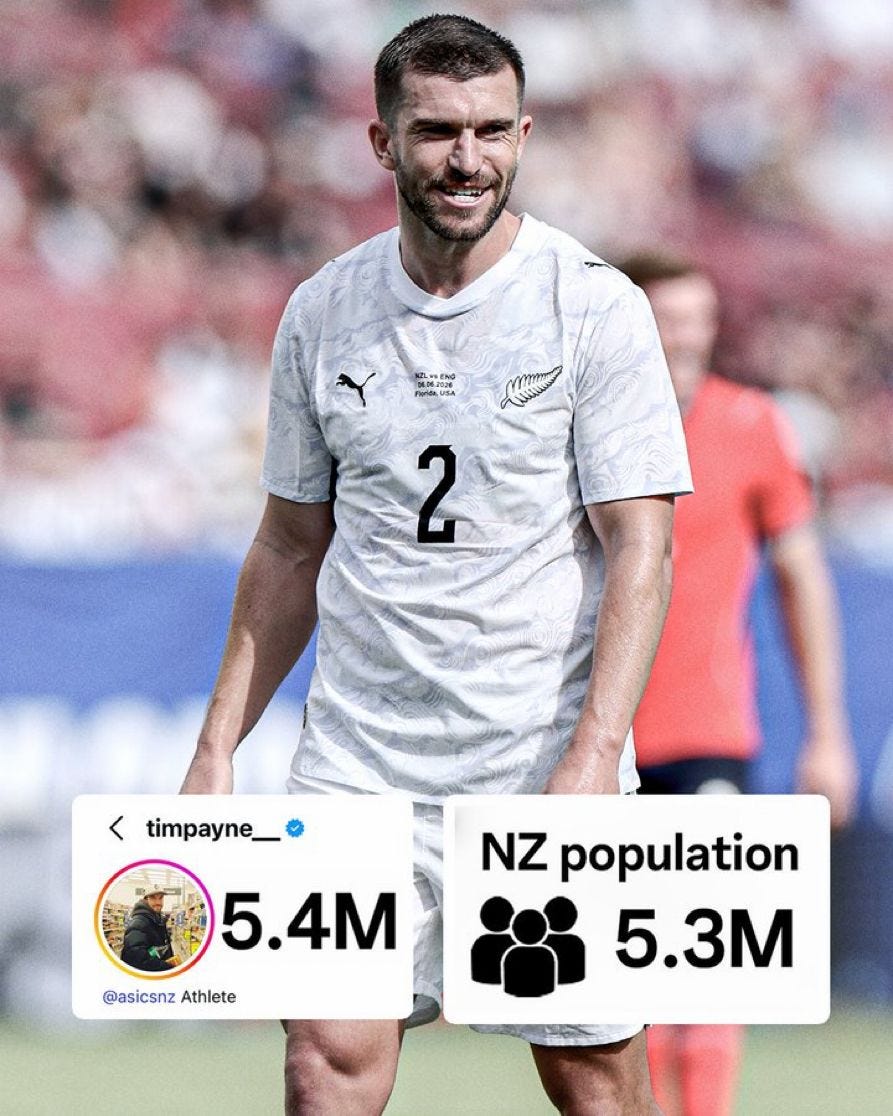
For most of his career, Tim Payne was the kind of footballer only his family, teammates and a handful of die-hard New Zealand fans could identify. Not the star. Not the captain. Fifteen years of gruelling training sessions, injuries and quiet sacrifices — the kind of work that builds a professional footballer from the inside out, in stadiums where the attendance figures were more embarrassing than inspiring.
Then an online campaign targeted FIFA’s World Cup to make the tournament’s least famous player famous. Within days, Payne’s social media following exploded past five million — more than the entire population of New Zealand. The internet had done what the internet always does. It celebrated the sudden outcome while completely ignoring the fifteen years of work it took to get there.
The scorecard the internet wrote for Tim Payne had nothing to do with football.
It had everything to do with novelty.
Which is worth remembering as the tournament kicks off. Because 104 matches are about to compete for your attention, your sleep and your marriage. Choose wisely.
WORLD CUP FOR PEOPLE WITH JOBS

The FIFA World Cup has expanded to 104 matches. Students think this is wonderful. Those of us with bosses, school fees, spouses and WhatsApp groups requiring immediate responses are conducting a different exercise.
The question is no longer “What’s on?”
The question is “What can I realistically watch without getting fired?”
CALL IN SICK
England vs Ghana (23 June, 11PM EAT) — History, pride and continental honour in one fixture. Non-negotiable.
South Africa vs South Korea (25 June, 4AM EAT) — Bafana chasing magic. Set the alarm or regret it.
Croatia vs Ghana (28 June, Midnight EAT) — Could decide whether Ghana’s bags get packed early.
Cancel The Meeting
Uruguay vs Spain (27 June, 3AM EAT) — Two football aristocrats. One mistake changes the entire draw.
Tunisia vs Netherlands (26 June, 2AM EAT) — North African resilience meets Dutch efficiency.
Senegal vs Iraq (26 June, 10PM EAT) — Senegal’s golden generation faces another examination.
Stream On Your Phone
Morocco vs Haiti — Moroccans are no longer the surprise. Managing expectations is harder than chasing them.
Algeria vs Austria — Could quietly shape the knockout bracket.
Portugal vs Colombia — Two nations equally capable of brilliance and self-destruction.
Rugby Notebook
While football dominates the headlines, rugby delivered its own reminder that sport remains gloriously unpredictable. The Hurricanes ended a ten-year wait for a Super Rugby Pacific title by dismantling the Chiefs 60-5 in Wellington.
It was not a final. It was a demolition.
Leading 29-0 at halftime, the Hurricanes ran riot — one of the most one-sided championship performances in professional rugby history.
Meanwhile attention shifts to the All Blacks squad announcement. Every coach has a scorecard. Every player believes they have done enough. By Tuesday morning, somebody will discover those are not always the same thing.
THE SCORECARD THAT SURVIVES
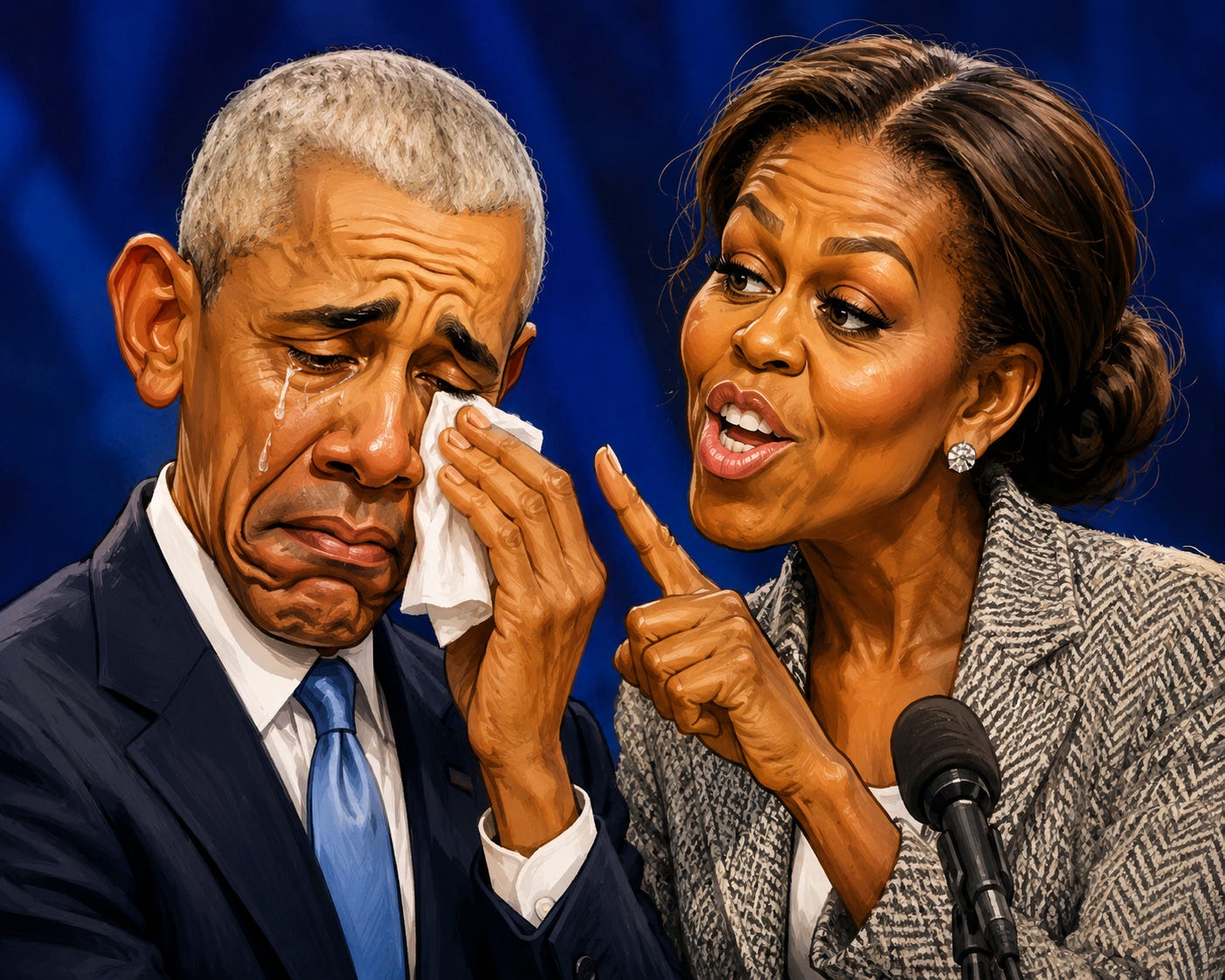
Last week, at the opening of the Obama Presidential Center in Chicago, Michelle Obama stepped to the microphone and quietly changed the register of the room. While the world measures Barack Obama through election victories and approval ratings, Michelle spoke about pressure, character and the moments nobody sees. She looked at him directly:
“Not once did you melt from the heat. Not once did you let it harden you.”
The room went quiet. Because she wasn’t describing a President.
She was describing a man she had watched up close when the title was off and the cameras were gone.
That is the private scorecard.
The one that no election result, no viral moment, no online campaign can produce.
Lina Githuka spent six years rewriting the institutional scorecard at KWAL, policy by policy, person by person. A male colleague told her: “This is the kind of organisation I would want my daughters to work for.” That is someone saying — what you built here changed what I believe is possible. Tim Payne spent fifteen years writing his own scorecard in empty stadiums. The internet rewrote it in 48 hours and called it his story.
The question was never what’s on the scorecard.
The question was always who gets to write it.
Lina decided she did. My colleague never asked. Michelle reminded a room full of powerful people that the most important scorecard is kept by the person who sees you when the performance is over.
If the people who know you best were handed a microphone today — would they describe your achievements?
Or would they describe your character?
Father’s Day Dedication
To every man who has ever helped raise a child.
Whether the child carried your surname or not.
Whether they called you Dad or Uncle.
Whether they lived in your house or simply passed through your life for a season.
Thank you for showing up.
Thank you for trying.
Thank you for carrying more than you said.
The world needs more good men.
Happy Father’s Day.
Same Forest. Different Monkeys.
Mubarikiwe. Jah Bless.
Go with song
Double edged sword... Two sides of physical strength each with its own outcome. Ni sori basi... 😅