
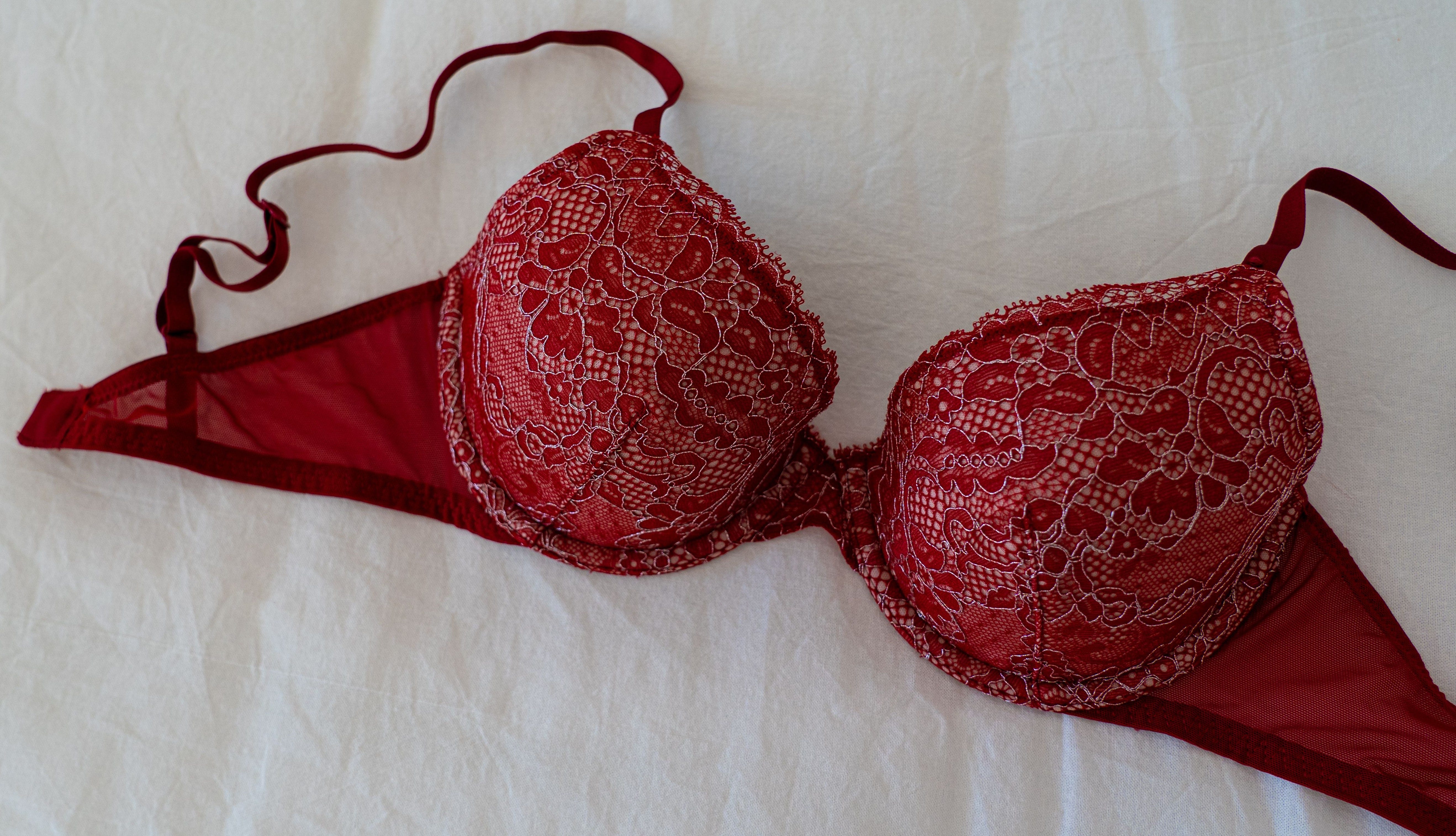
In my early days of building a sales consulting business, I entered a deal with my friend Ama, proprietor of Booby Trap Lingerie.
Ama had an entire room of bras and panties where customers came for viewing, fitting and wine tasting. I was allowed into the room when it was empty.
During fittings, I was politely directed to the TV Room, given the keys to the whisky cabinet and asked to wait until summoned.
I accepted this discrimination because I had received what I considered product-knowledge training.
Brasserie basics: band size and cup size.
Thirty-six C. Forty D. I could say the numbers with the confidence of a man who had learnt two French words and was already correcting the waiter.
This week, while researching for this article, I called another lingerie entrepreneur—an engineer who became an accountant before putting all that accumulated knowledge into selling bras.
Let’s call him Wemby.
He gave me the Executive MBA.
Gentlemen, welcome to Bra Sizing for Dummies.
The number (36, 38) is the band: the measurement around the torso, just beneath the breasts.
The letter (D, E, F, G, H, E, EE) is the cup, calculated from the size of the breast.
Brands and sizing systems vary, which is why “my wife looks roughly like you” is not a specification.Never enter a lingerie shop, study the attendant’s chest and use her as your wife’s measuring cup.
That is not shopping. It is preparation for a commission of inquiry.
The safest method is to steal a bra your wife already finds comfortable and read the label. You must know where the bras live, remove one without disturbing the arrangement and leave the house carrying it.
If your daughter, watchman or neighbour finds you at the gate holding a 38D, your explanation—”It is for research”—will not improve matters.
There is another method. Wait until your partner falls asleep, then use the hands God gave you to estimate the merchandise. You must later preserve that exact grip, find a tape measure and persuade somebody in a lingerie shop that the distance between your thumb and forefinger is an internationally recognised standard.
The woman buying beside the road has a different challenge. There is no fitting room, and whatever does not fit returns to the pile. She therefore tries the bra over her dress. Women recognise procurement under difficult operating conditions.
At Sh300 to Sh500 sits the Nduthi bra: affordable, available and likely to get you there, although comfort and safety were not included in the quotation.
Between Sh2,000 and Sh5,000 is the Probox range—better finishing, less noise and a decent chance everything arrives together without the uniboob effect. These are the Kaunda suits of bras: dependable, respectable and likely to have a half decent return policy.(and could also come in pairs)
Then there is the Ferrari. It can cost upwards of Sh20,000 before you add the matching underwear, thongs and other trimmings that mysteriously cost more despite containing less material.
Bras are engineering. Nursing bras need access without surrender. Sports bras control movement; some compress everything into one broad based coalition while others insist on following the constitution and separation of powers.
A strapless bra is independent suspension, like the Subaru Outback’s all-wheel drive. Beneath a linen dress or wedding outfit, that unseen engineering is what you are paying for.
Then comes the evening scene many men recognise. Your partner enters the house and removes her bra before she has removed her shoes or finished saying hello. Some husbands take this as an invitation.
Breathe brother.
She is not inviting you. She is terminating an uncomfortable eight-hour contract.
Bodies change through weight loss, pregnancy, hormones and age.
Bras stretch.
A garment that rides up, spills, gaps or requires negotiations every 30 minutes is applying for early retirement.
What fitted the woman you married five years ago may not fit the woman now carrying school fees, targets, children, ageing parents and half the emotional administration of the household.
That is where this story develops some weight.
Ama’s fitting room taught me that the part carrying the load is rarely the part receiving compliments.
Which is how a room full of bras led me to a basketball player, a computer-chip company and an artificial-intelligence business with the cuddly name Hugging Face.
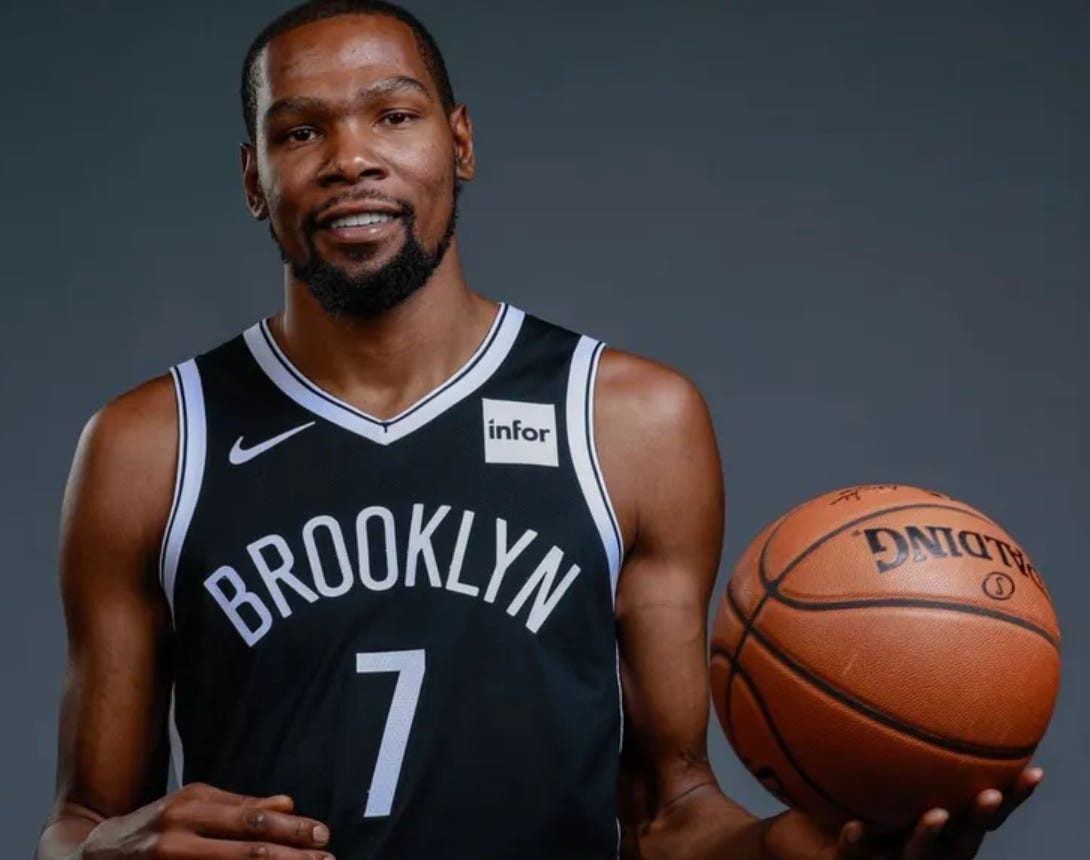
Kevin Durant is one of the finest basketball players of his generation. Away from the court, he and his business partner Rich Kleiman invest in young companies. Sports-business writer Joe Pompliano says they placed $100,000 into Hugging Face’s seed round and another $150,000 into its next funding round.
Hugging Face began as a consumer chatbot. It later changed direction and became something much more valuable: the place where artificial-intelligence developers share models, datasets and tools.
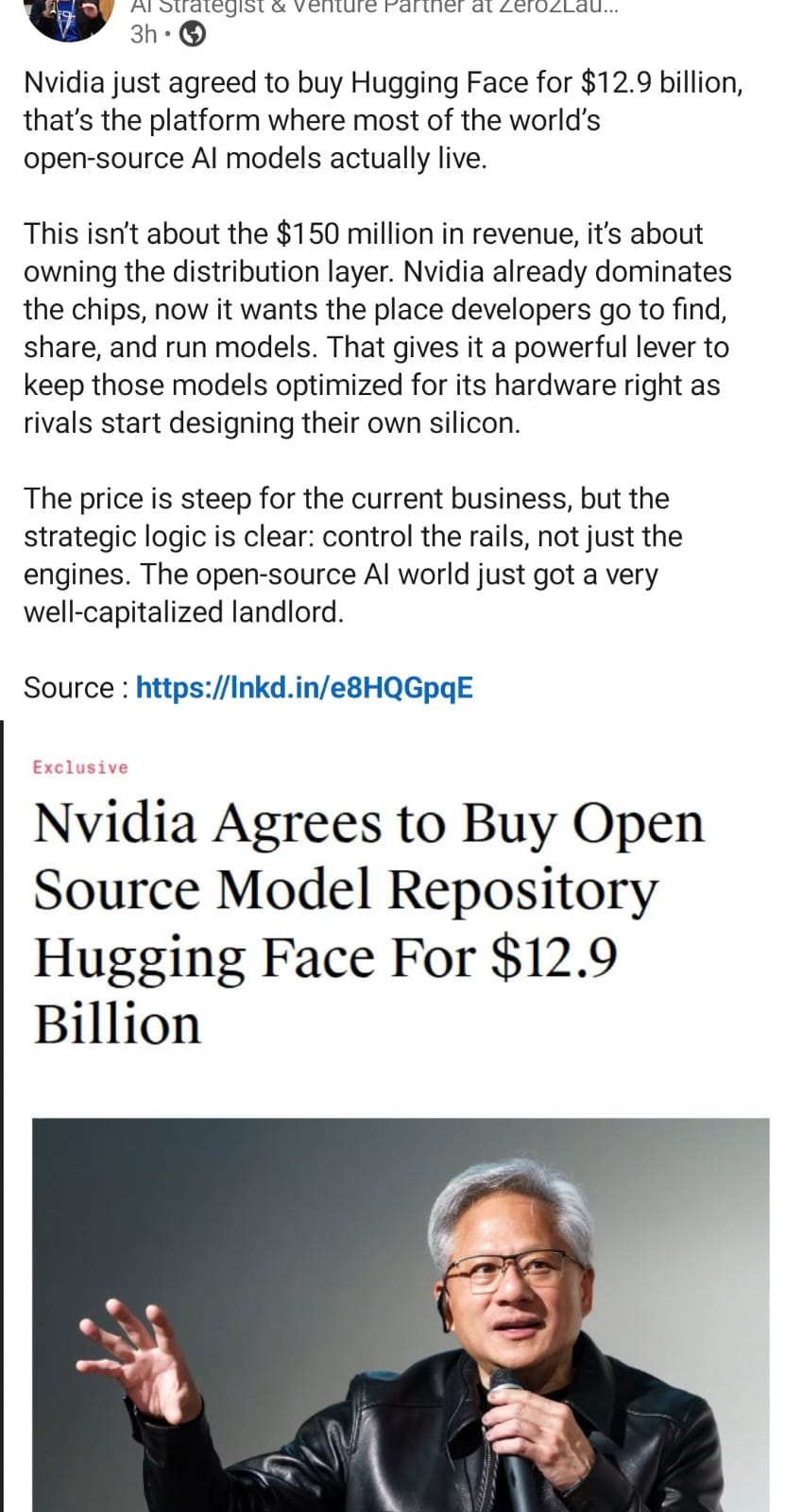
Then there is Nvidia. If artificial intelligence were a construction boom, Nvidia would be selling much of the cement. It designs the powerful computer chips behind many AI systems and has become one of the world’s most valuable companies.
Reports this week said Nvidia was acquiring Hugging Face for $12.9 billion. Neither company had publicly confirmed a completed transaction as this article went to press, so the champagne must remain in the fridge. Pompliano estimates Durant’s $250,000 could eventually return more than $60 million after dilution.
The numbers are estimates. The timing is the story.
Durant entered before Hugging Face became fashionable—before the conference panels, AI vocabulary and cousins announcing they had always understood machine learning.
Football has its own early investors. They do not receive shares. They pay school fees, matatu fare, tournament costs and Saturday mornings beside dusty pitches while pretending not to calculate what the dream is costing.
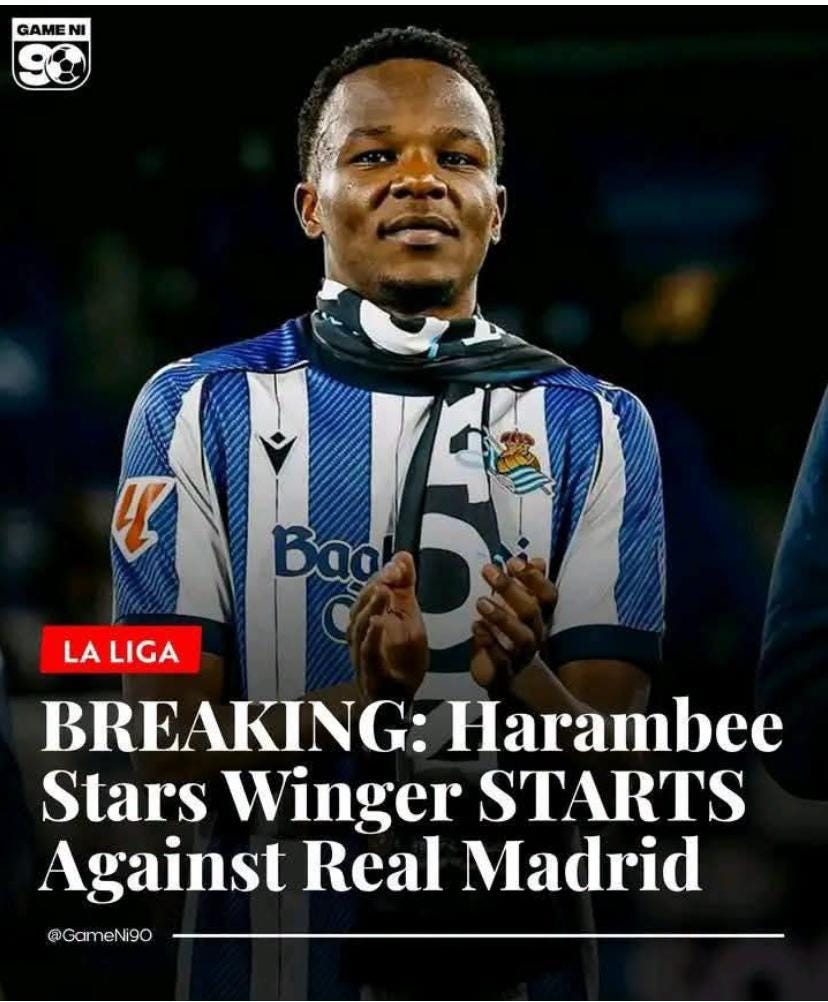
Last Wednesday, 23-year-old Job Ochieng started for Real Sociedad against Real Madrid at the Santiago Bernabéu. His shot helped create Luka Sučić’s equaliser before Madrid eventually won 4–1.
On television, it looked as though a Kenyan had suddenly appeared among Kylian Mbappé, Vinícius Júnior and Jude Bellingham.
Job began at Express Soccer Academy, moved to Ligi Ndogo in Nairobi and left for Spain at 17 after his family and community helped finance the trip. In Gran Canaria, the agency handling his move stopped supporting him. He was stranded. People at CD Maspalomas found him accommodation, work and a route back into football. He later joined Real Sociedad and climbed through its C and B teams.
The Bernabéu did not create Job Ochieng. It switched on brighter lights.
From Job’s journey we move, naturally in Kenya, to drinking. A photograph circulated of a number plate reading KEG 500L. It appears to be a mock-up, not an issued plate. NTSA says future combinations cannot be reserved before their series becomes available.

Facts settled, admire the ambition.
Most Kenyans take their keg 500 millilitres at a time.
This person ordered industrial.

Place beside it the photograph of Uhuru Kenyatta drinking Senator Keg in Kisumu during the 2017 campaign, William Ruto smiling behind him, and politics joins the round without being invited.
The laughter fades when we ask what is actually inside the bottle. A Euromonitor study commissioned by the Alcoholic Beverages Association of Kenya estimated illicit alcohol at 59 per cent of the market by volume in 2022. Its category estimates placed wine above 50 per cent, beer at 47, whisky 43, vodka 37 and rum 32. They are estimates, not a census of every bottle, but counterfeit alcohol can do more than cheat KRA. It can blind or kill.
Silas Nyanchwani brings the story home in his essay, “Shosho’s Last Batch.” He remembers Christmas 2003, when his uncles persuaded Bhabha, his Kisii grandmother and a retired brewer, to make chang’aa one final time.
Maize, sprouted finger millet, fermentation, buried pots.
No PowerPoint, no consultant with a laser pointer.
Knowledge lived in her hands.
Silas calls it “a zero-waste circular economy” before consultants invented the phrase and started charging for it.”
I felt seen and attacked.
His closing line carries the loss: “Bhabha’s last batch deserved better than to be the end of a lineage. It should have been a founding vintage.” Read Silas’ article here.

Somewhere in your office, one employee knows how everything actually works. At home, your mother carries a recipe, a family history or the truth about that piece of land. We call it experience until the carrier leaves. Then we call an emergency meeting.
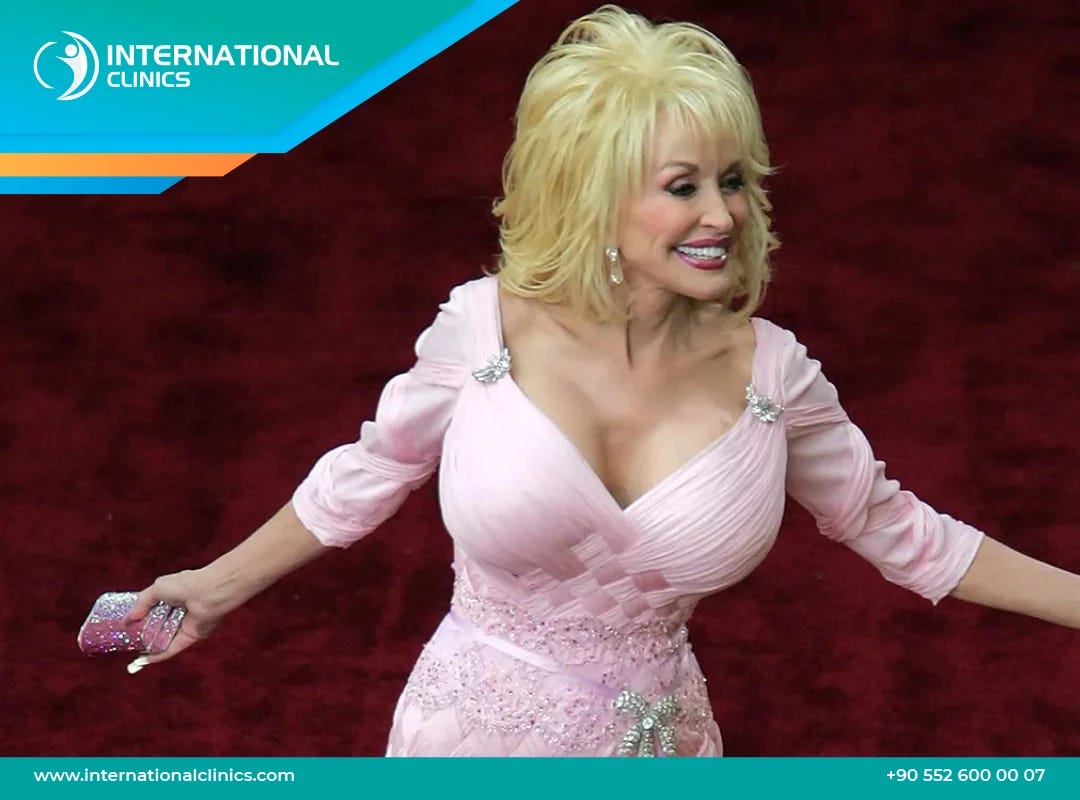
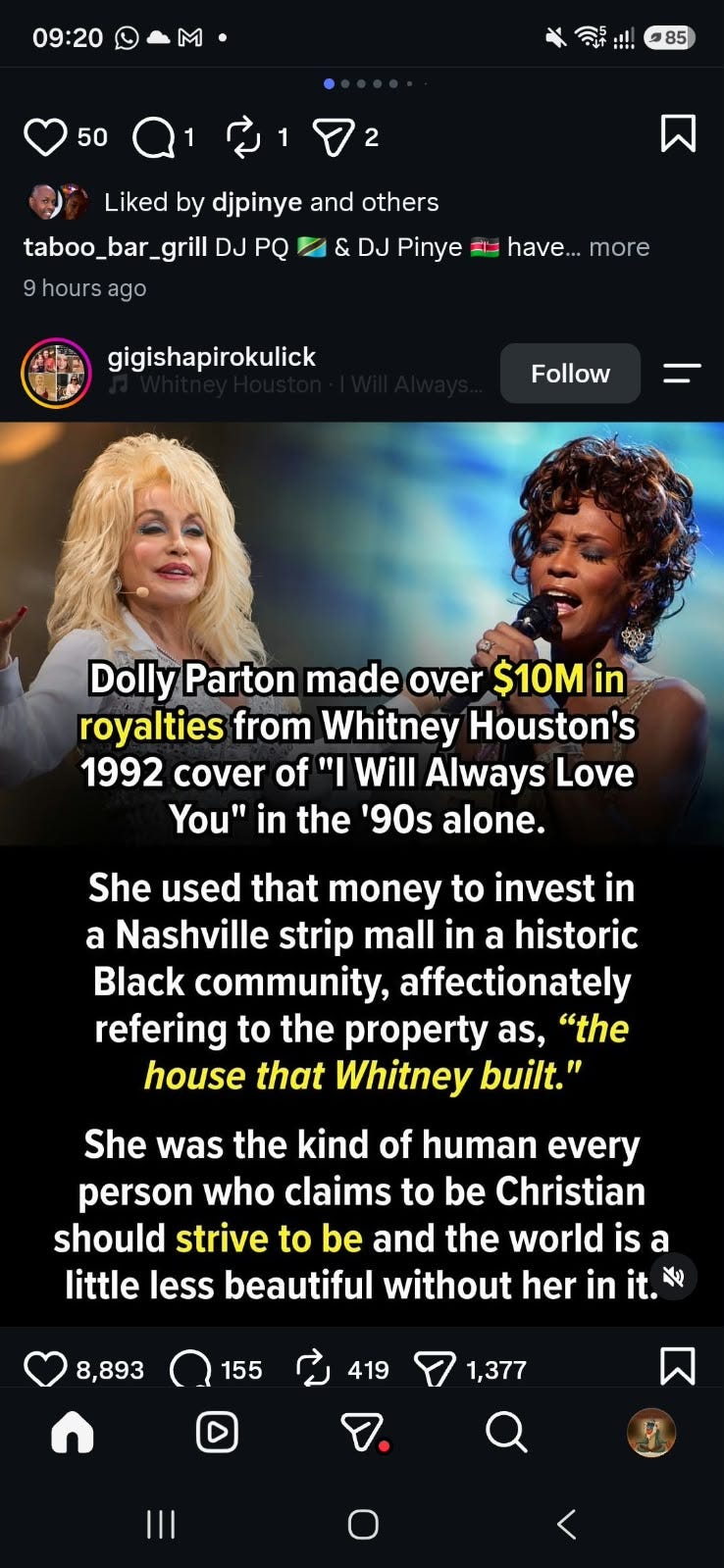
Dolly Parton understood ownership. People discussed her cup size while she retained her publishing rights. She wrote “I Will Always Love You” in 1973. Nineteen years later, Whitney Houston’s recording spent 14 weeks atop the Billboard Hot 100. Parton used some royalties to buy property in a predominantly Black Nashville neighbourhood and called it “the house that Whitney built.”
Whitney supplied the magnificent voice. Dolly still owned the song.
Dolly also started the Imagination Library because her father could not read or write. By 2025, it had gifted 304,539,509 books across five countries.
Amazing kindness, amazing humanness even when her bank accounts overflowed.
As we start a new month, why not check your current size. Does everything fit?
What talent have you been nurtuting and is time to let go?
What idea, process or customer relationship have you allowed somebody else to own?
Rest in peace, Dolly.
Same Forest, Different Monkeys.
Mubarikiwe. Jah Bless.
Go with song. (Dolly could rap too)