
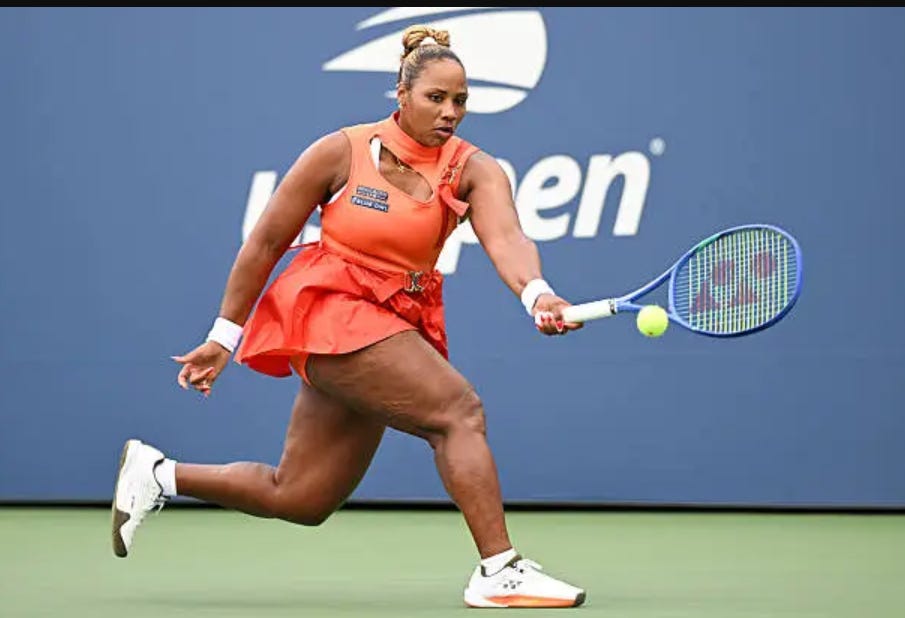
Every woman knows her measurements. She also knows they are rarely just numbers.
In the wrong hands, a waist becomes an opinion. A dress size becomes a diagnosis.
A changing body becomes evidence before a court nobody remembers appointing.
And before anyone becomes uneasy, this is not another man volunteering his expertise on women’s bodies. Men who cannot locate their own trouser size without checking the label and occasionally asking the woman who bought it, should approach that subject with humility.
This is about what happens when the people holding the measuring tape mistake the measurement for the woman.
Taylor Townsend knows something about that.
In 2012, she was sixteen, the world’s number-one junior tennis player and reigning Australian Open junior champion. By the usual measurements of sport, Taylor was succeeding.
The United States Tennis Association looked at the same young woman and worried about her weight. It reportedly withheld tournament funding while she worked on her fitness. Her mother paid for her to compete at the US Open herself.
Taylor stands about five-foot-seven and weighs approximately 77 kilograms. While researching this story, I asked a female friend what dress size that might be in a Kenyan setting.
She proceeded to give me the full tutorial.
Her best estimate was 10–12 in America and 14–16 in Britain or Turkey. In China, Bangkok or Vietnam, she said, the label might carry a number I dare not publish. I have learnt enough new words—misogyny, objectification and narcissism—to know when to put down the measuring tape and move away slowly.
The lesson was more useful than the number. Sizes change between countries, shops and manufacturers.
The woman does not.
WHEN THE TEST MEASURES THE WRONG THING
Fitness is measurable. So are results. But body shape, fitness and ability are not interchangeable measurements, however often people squeeze them into the same dress. Last Friday, Taylor returned to the US Open and won the women’s doubles title alongside Kateřina Siniaková, completing her career Grand Slam in doubles.
Wimbledon. Australian Open. French Open. US Open.
The body they once considered unsuitable had answered with the one measurement sport cannot argue with: Results.
Taylor did not prove fitness was irrelevant. Elite sport would laugh at that. She proved something uncomfortable: the people holding the tape had allowed one measurement to become the whole story.
Women know how easily that happens.
A dress size enters the room quietly. Soon it is offering opinions about health, beauty, discipline, motherhood, desirability and whether somebody has “let herself go.”
The number said none of those things.
People did.
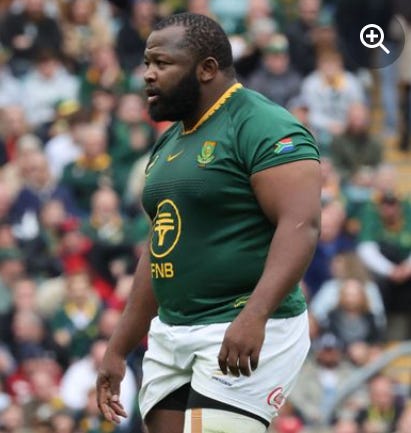
Ox Nché understands what happens when somebody measures differently. He was once a chubby child playing soccer in the Free State, South Africa. Fortunately, his coach saw not a failed winger, but a future rugby prop.
Ox is five-foot-nine and weighs about 122 kilograms.
Put him on a soccer field and he may look like a Teletubby in silk shorts.
Put him at loosehead prop and he becomes one of rugby’s most destructive forces.
Same body. Better question.
Not, “How do we make this child smaller?”
But, “What job is this body built for?”
I have spent enough time around rugby teams to know how easily coaches fall in love with the athlete drawn inside their heads.
Good coaching is sometimes nothing more complicated than looking twice.
Rassie Erasmus (South Africa Rugby’s Double World Cup winning coach) has turned looking twice into an art.
RASSIE’S BENCH AND KENYA’S THIRTY-EIGHT
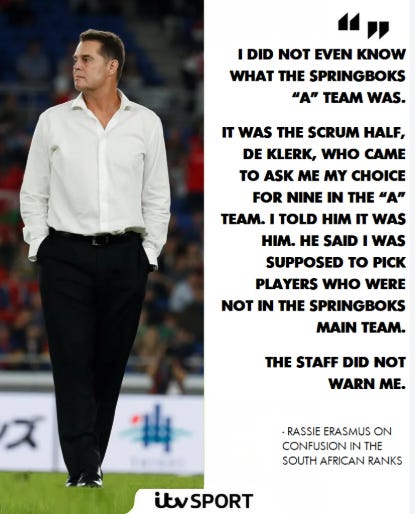
On Saturday night in Baltimore, Rassie’s Springboks completed a 3–1 series victory over the All Blacks, winning the final Test 43–28.
South Africa had lost the opener 33–16.
There was no funeral.
Rassie did not burn the playbook, sack the forwards and ask the South African Fans to appoint a commission of inquiry.
He adjusted. The Boks won the next three Tests.
That is what depth gives a coach. He can change combinations without changing identity and release another group of forwards after the first has softened the ground. By the time the All Blacks look up, three gladiators who have leaned on them for fifty minutes are walking off.
Unfortunately, three other giants masquerading as bomb-removal experts are running on. Rassie’s genius is not simply selecting big men. South Africa has produced large men since before refrigerators needed electricity. His genius is knowing which body, skill and temperament belong to which moment.
A strong bench provides different answers.
Then there is Kenya’s Anti-Counterfeit Authority.
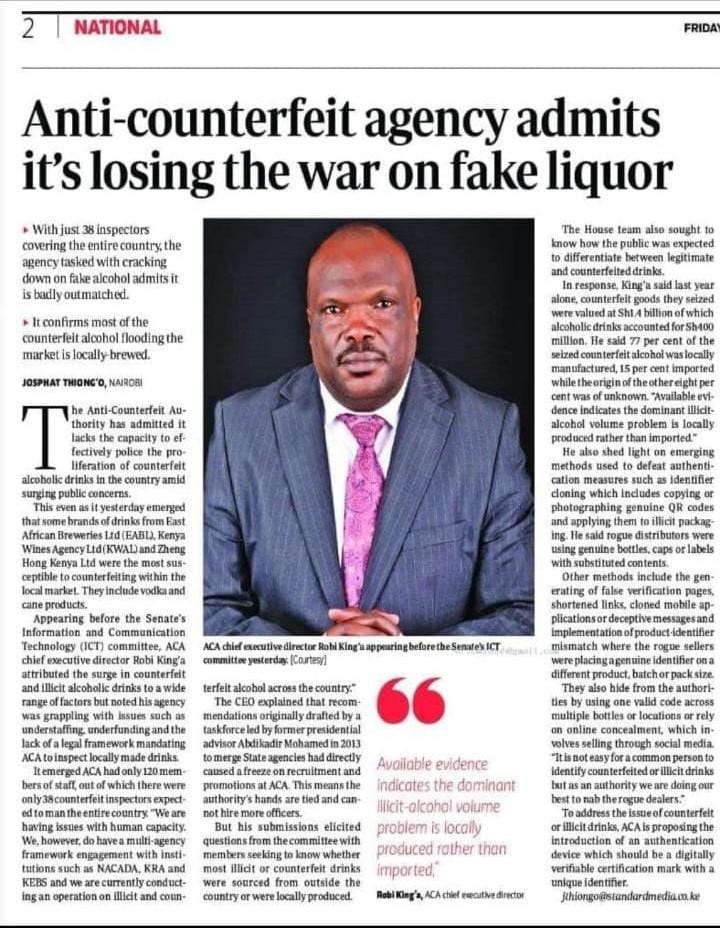
While Rassie can summon another international-quality forward, ACA chief executive Dr Robi King’a told the Senate his organisation has 120 employees.
Only 38 are counterfeit inspectors.
Thirty-eight people covering 47 counties and every category of counterfeit goods: fake medicine, cosmetics, electronics, spare parts and every product whose packaging arrived before its quality. You could fit all 38 inside one large Nairobi electric bus and still leave space for a preacher, three sacks of warus and somebody carrying a kienyeji chicken lovingly purchased by Khukhu’s (grandma) from her chama dividend.
This is what happens when an institution receives a Springbok-sized mandate and a village-team bench.
Perhaps the inspectors are not sleeping.
Perhaps there are simply too few to remain awake everywhere.
TWO TEAMS, TWO CLOCKS
Fake alcohol brought King’a before the Senate. He told the Senate committee that 77 per cent of the counterfeit alcohol his officers had seized was locally manufactured. Not smuggled. Not imported. Brewed here, bottled here, sold here.
Ministry of Interior’s nationwide crackdown shut down 12,150 unlicensed bars and 6,500 premises operating illegally near schools.
King’a traced the shortage to a recruitment freeze following a 2013 proposal to merge state agencies. The freeze remained. The market did not.
Mchimba kaburi huingia mwenyewe.
Keep digging beneath the people protecting the system and eventually all of us may fall in.
I have sat in enough EXCO meetings to recognise the next question:
“Can the team be more innovative?”
Fair enough. But innovation should not become a polite instruction for five people to do the work of twenty while remaining cheerful and available on WhatsApp.

This week the NFL offered another experiment. The San Francisco 49ers and Los Angeles Rams travelled to Melbourne facing the same journey and brutal time difference.
The 49ers arrived more than a week before kickoff. They trained, adjusted their sleep and forced their bodies towards Melbourne time. The Rams landed roughly a day before the game. Their plan was to remain close to California time: arrive, play and leave before jet lag completed the paperwork.
They had studied the journey and made a deliberate bet.
Then the 49ers beat them 27–7.
Travel cannot explain every mistake. But results are rude. Once the scoreboard appears, every clever theory must answer questions. One team looked prepared for Melbourne. Part of the other seemed stranded between Fiji and Samoa, asking the pilot whether it was still Thursday.
Preparation guarantees nothing. It removes some of failure’s hiding places.
THE LABEL AND THE LIFE
The wrong clock follows us home.
A salesperson enters a new market carrying yesterday’s script. A manager inherits a younger team but speaks the language of people who retired. A couple enters a new season, each demanding the person they married fifteen years ago.
Sometimes we have simply not adjusted.

Fr Sandro Ferretto served for years as a Catholic priest in Kenya. Then life changed.
At 55, the Italian former priest married Sharon Jepng’ok, a beautiful Tugen lady from Baringo South, in a Koito ceremony. It reportedly took place where he once served. People who knew him as Father welcomed him as Sandet—the groom.By his family’s account, the paperwork was long settled before the drums started in Kasiela, laicisation completed, Rome’s approval given.
The harder question was never the process. It was this:
What do you do when the life that once fitted you no longer describes who you have become?
Some remain inside an old identity because leaving may disappoint others.
Priest. Executive. Coach. Wife. Husband. Provider. Strong one.
Useful labels. Heavy labels. Sometimes sacred labels.
Taylor refused to let someone else’s picture define her. Ox found the field where his body made sense. Rassie changed the answer without abandoning the mission. The 49ers adjusted to where the game would be played.
Sandro chose his next title.
Husband.
Strong decisions rarely look dramatic when you’re standing close to them. Most of the time they look like patience wearing a disguise. A coach who waits one more season before cutting a player, a woman who ignores a label until the label runs out of power over her, a man who lets a title go quietly instead of defending it loudly.
Next week, look twice before you decide what a body, a bench or a life is actually built for:
at the child carrying the “wrong” shape,
the employee who doesn’t fit the picture in your head,
the institution running on a bench too thin for its mandate,
and the life whose old label has simply grown too tight to breathe in.
Where might you still be judging someone, you included,
by the wrong measurement?
Tonight, CirCute and Jo-el sing Manyake: (All Sizes)
Because labels may be familiar, but only you know whether they still fit.
Same Forest. Different Monkeys.
Mubarikiwe. Jah Bless.
Go with song.
How I accepted being known as 'Wangari wa MaThigh'... 😂😂😂 and ran with it ...