

Last week, my timeline introduced me properly to King Kalala.
I knew the voice—Kenya knows that voice—but for those whose children have to explain the internet to them, her real name is Prudence Chepkirui. She is an Eldoret-born content creator, podcaster and former radio presenter, built on blunt commentary and the confidence of somebody who appears to have removed embarrassment from her list of possible outcomes.
Years ago, somebody rejected her. Kalala told the camera that this person was not boarding. For our readers outside Kenya, that does not involve public transport.
Dude simply was not biting.

Kalala did not vanish quietly. She announced the next course of action:
“We go back to the drawing board. We restructure. We come back. We conquer.”
Kenya laughed, saved the clip and moved on.
Then, on July 21, Kalala announced that she was expecting her first child. Within hours, somebody entered Kenya’s enormous digital wardrobe, recovered that old clip and returned it to the timeline.
That retrieval finished me.
The pregnancy is her private happiness, generously shared with the public. The joke belongs to the internet, which placed an old rejection beside happier news and declared that the drawing board had worked. Whether the two moments have anything to do with each other is Kalala’s business. Kenya was simply not going to waste such excellent archival material.
Congratulations on your baby bump Prudence …..

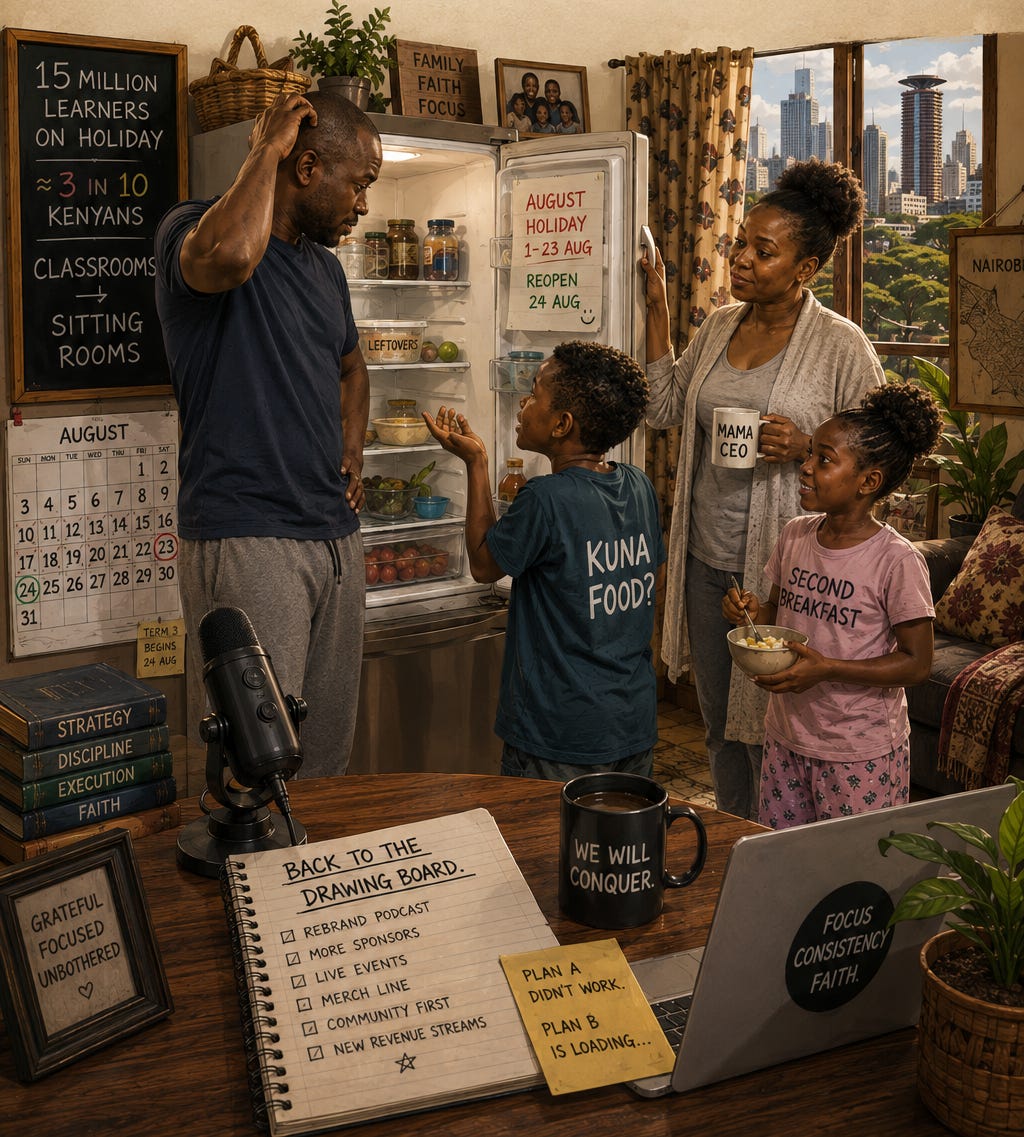
On July 31, schools closed for the August holiday. They reopen on August 24. Using the latest available enrollment figures, roughly 15 million learners—close to three in every ten Kenyans—have exchanged classrooms for sitting rooms.
By Monday morning, parents will not require CCTV to confirm their existence.
The refrigerator door will provide live data.
Somebody will open it, inspect the contents as though food might have arrived while the door was closed, then ask, “Mum, kuna food?” The child who survived an entire school afternoon on one cup of porridge will suddenly require breakfast, second breakfast, lunch and something before supper.
One parent summarized the August economy better than any Treasury forecast:
“Wanakula kama mchwa.” (they eat like termites)
The holiday brings report forms, new shoes nobody budgeted for and calculations involving fees, transport and third term. In some homes, the marks will not match the confidence with which the child left for school.
Shouting may provide temporary relief, but eventually somebody must establish what happened, what can still be repaired and how much it will cost.
August has turned the family dining table into a drawing board.
The corporate report form is also out. January’s targets have now met six months of delayed budgets, stubborn costs and an economy that does not read PowerPoint.
Consider financial services. By the published count, there have been 13 announced senior leadership movements touching ten institutions. They include Rebecca Mbithi at Ecobank Kenya; Birju Sanghrajka and Gladys Warirah taking the CEO and CFO roles at Standard Chartered Kenya; John Okulo moving from KCB to lead Sidian Bank; Anne Kinuthia-Otieno leaving Airtel Money for Visa; and Michael Mutiga moving from Safaricom to Stanbic.
Then came Abdi Mohamed’s announced move from Absa Kenya to I&M Bank, with Yusuf Omari named interim chief executive at Absa.
Thirteen movements. Ten institutions.
Perhaps they are all coincidences. Each institution has its own circumstances, and a collection of announcements is proof that an entire industry is moving. Still, the similarity in the background is difficult to miss: upward movement, pressure on growth, customers becoming harder to retain, technology reshaping distribution and boards looking at the second half of the year with sharpened pencils.
Corporate life may surprise us later, but 13 senior movements touching ten institutions are consequential enough to bring into a conversation today.
The appointment is the visible part. The more difficult question follows later:
was the problem the person, the position or the plan?
I have worked with several organizations after leadership changes. By the time the consultant arrives, everybody has an explanation.
Marketing cries no budget. Sales blames the product.
Operations blames both.
Finance produces a spreadsheet proving that all three departments are too expensive to keep.
The executive who left becomes responsible for everything from declining margins to the weather.
Then somebody says, “We need to go back to the drawing board.”
Quite right. But the drawing board is not where inconvenient history disappears. It is where you look at it without the departed executive available as your universal answer.
Uganda carried a more complicated history into the boxing ring at the Commonwealth Games in Glasgow.
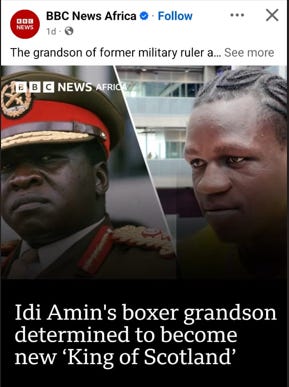
Its super-heavyweight boxer Aziz Abdul, aka Ringo, is a grandson of Idi Amin. Amin ruled Uganda between 1971 and 1979. His regime was responsible for mass killings, disappearances and the expulsion of about 80,000 Asians.
Before politics, Amin had also been a boxer. Later, among the grand titles he awarded himself, he claimed kingship over Scotland—a piece of history that eventually helped inspire the title of Giles Foden’s novel and the 2006 film The Last King of Scotland.
Uganda knew all that before selecting Aziz.
It still placed him in the national team, put the flag on his kit and sent him to Glasgow. Nobody had failed to notice his surname or examine the family history. Uganda’s decision was more significant than that: it had looked at the past and decided the grandson could not be tried for the grandfather’s crimes.
Aziz drew more attention to the connection himself. Before the Games, he described Amin as an inspiration and joked about becoming Scotland’s new king.
His quarterfinal opponent was England’s Damar Thomas. Aziz received a standing count in the first round, lost a point for striking during a break and was disqualified in the third for using his head during a clinch. He denied doing it deliberately and alleged bias. Commonwealth Sport President Donald Rukare ( a Ugandan) rejected that allegation.
That is the correct sanction: Games officials disqualified Aziz for what happened in his bout. Uganda had selected him to represent the country despite the weight of his family name; the officials judged his conduct in the ring. These were separate decisions.
There was something almost indecently tidy about the scene—Idi Amin’s grandson boxing in Scotland after invoking his grandfather’s old claim, then leaving the competition because of a headbutt.
But coincidence is not inheritance.
Aziz owns the foul.
He does not own the crimes committed before he was born.
Same Forest. Different headbutts.
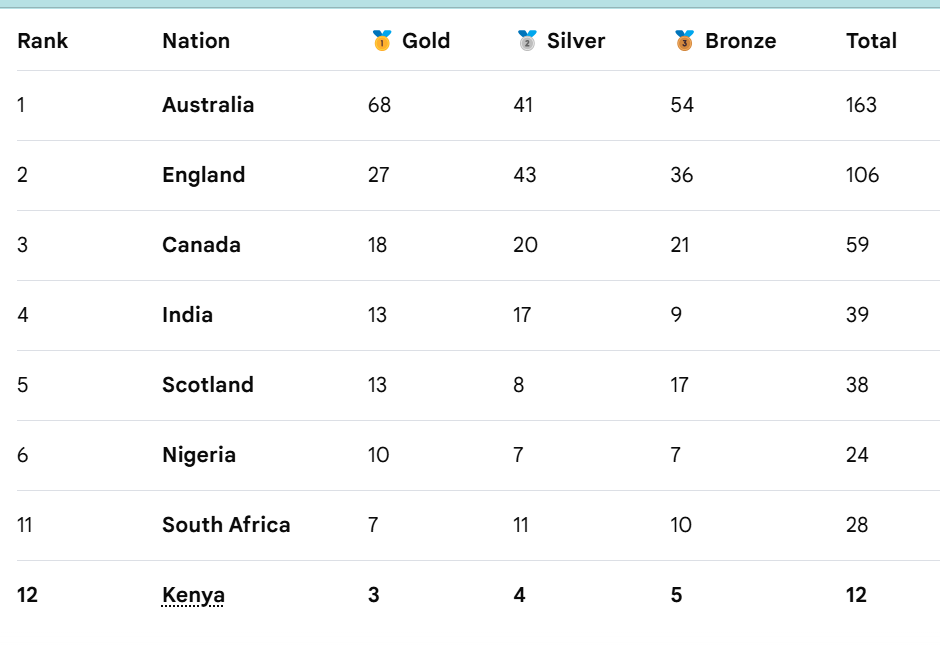
Glasgow gave Kenya a cleaner report form. The country entered 93 athletes across 12 disciplines and finished 12th with 12 medals: three gold, four silver and five bronze.
Eleven medals came from athletics. Kenya swept the men’s 3,000-metre steeplechase through Edmund Serem, Simon Koech and Amos Serem Bett. Faith Cherotich won the women’s steeplechase, while Mathew Kipchumba Kipsang took gold in the men’s 5,000 metres.
The only medal from outside athletics belonged to Joshua Amunga Mboya. His combined lift of 260 kilograms earned Kenya a bronze in weightlifting.
Celebrate the runners properly; they earned every cheer. Then look again at the figures. Eleven medals from one discipline and one from everywhere else is concentration wearing a tracksuit.
Nigeria collected 24 medals through several routes, including athletics, weightlifting, para powerlifting, boxing and judo.
Kenya’s runners remain our spear—polished, feared and still finding its target.
Joshua Amunga’s bronze asks whether we have built enough beside them.
Organizations live with the same risk. Dependence is sometimes renamed Key Accounts while the dependable product, salesperson or customer keeps delivering. Nobody asks difficult questions when the generator is humming.
Then July turned off the lights.
Zimbabwe suffered a nationwide blackout after a transmission fault. Tunisia experienced heat-related regional disruptions. Libya endured prolonged cuts. Ghana and Kenya both lost power on July 29, although Kenya Power described its interruption as widespread rather than nationwide because parts of Western Kenya and the North Rift remained supplied.
Different countries, different grids and different causes. Coincidences, certainly—not evidence of one coordinated African failure. What they shared was the speed with which pressure exposed weaknesses that ordinary days had allowed people to tolerate.
The same thing happens when the children come home, the largest customer leaves or the first-half figures arrive. Suddenly we discover whether the backup was real or merely mentioned at the strategy meeting.
When the lights go out, nobody wants to hear that the generator appeared in the PowerPoint. We want to know whether it starts.
That is the only useful question at the drawing board: what will work differently after we leave the room?
Parents have the report forms. Financial institutions have their half-year numbers and 13 announced leadership movements touching ten institutions. Kenya has 12 Commonwealth medals, but only one outside athletics. Several African power systems have stumbled for separate reasons.
They are not one systematic failure. They are coincidences carrying familiar warnings in their luggage.
There are still customers to recover, teams to rebuild and fees to reorganize before school reopens. There is time to ask whether the executive truly needed replacing or had inherited an impossible formation. Time to support the 20% carrying half the target while developing the people beside them.
Time to find another Joshua Amunga before our runners must carry nearly all the country’s hopes again.

So feed the children. Read the figures. Celebrate what worked.
Tell the truth about what did not. Move the people who must move.
Strengthen the systems that held.
Build the alternatives we postponed while everything appeared fine.
Then go back to the drawing board.
Restructure. Reorganize. Come back.
And conquer.
Long Live the Klan!!
P.S. A shout-out to the winners of the 2026 Dala Sevens. Kabras Sugar beat Menengai Oilers 17–5 to take the men’s Main Cup, while Mwamba Ladies defeated Kenya Harlequin 10–7 in the women’s final.
A special salute to the community clubs, Kenya Harlequin and Mwamba. Quins ended KCB’s winning streak with a 14–12 quarterfinal upset. Mwamba’s men also reached the semifinals before beating Quins 27–22 in the third-place playoff. Mwamba Ladies brought home the women’s title, while the Quins women finished second.
In a competition increasingly populated by institutional sides, the old community clubs arrived carrying history, volunteers, stubborn supporters and no intention of becoming museum pieces.
Community rugby is still boarding.
Mubarikiwe. Jah Bless.
Go with song.