
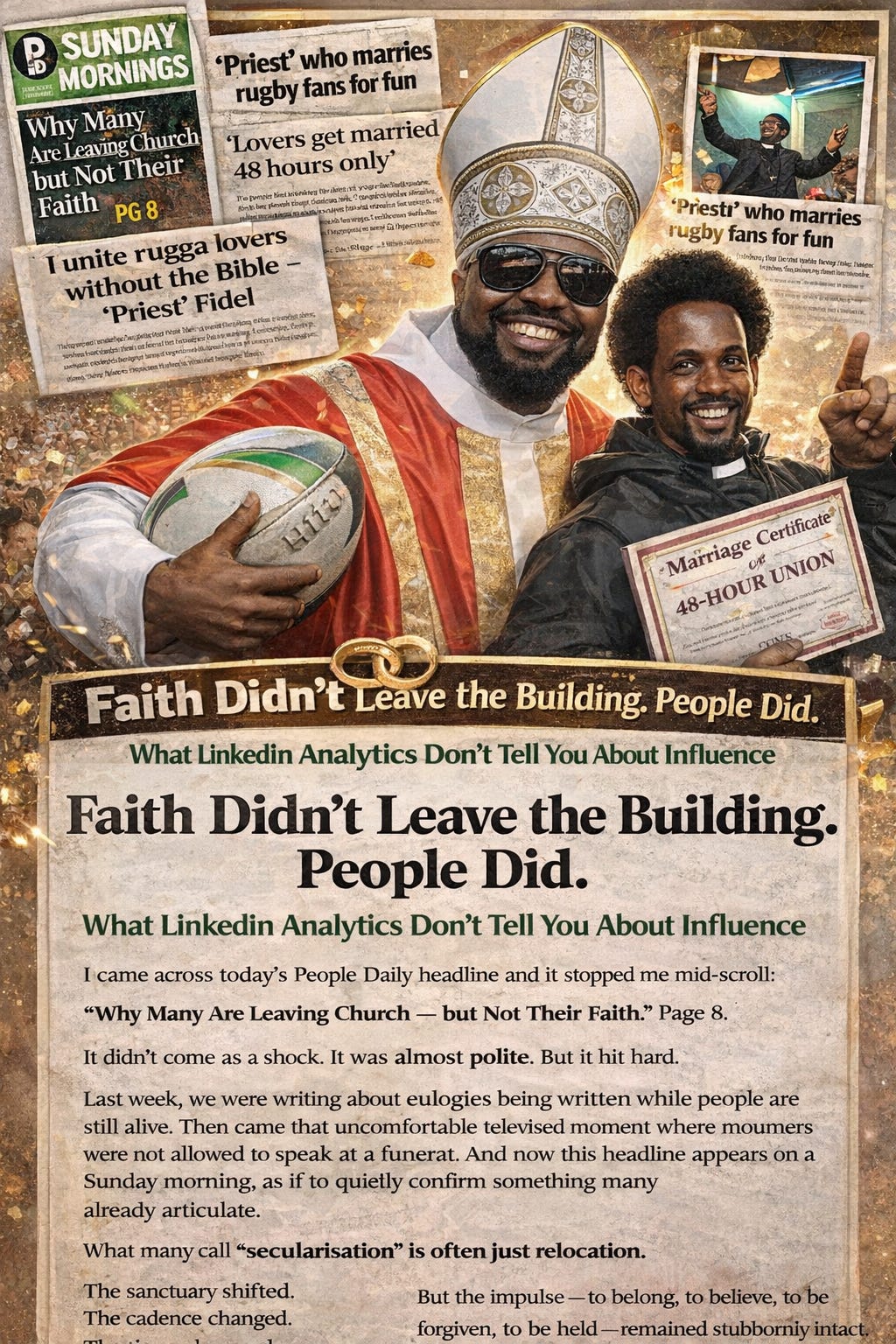
Image courtesy: Marine & Fidel
I came across today’s People Daily headline and it stopped me mid-scroll:
“Why Many Are Leaving Church — but Not Their Faith.”
Page 8.
It didn’t come as a shock. It was almost polite. But it hit hard.
Last week, we were writing about eulogies being written while people are still alive. Then came that uncomfortable online video moment where mourners were not allowed to speak at a funeral. And now this headline appears on a Sunday morning, as if to quietly confirm something many already feel but rarely articulate.
Faith didn’t leave the building.
People did.
What changed is not belief — it’s where belief found rhythm.
For many Gen X, millennials, and early Gen Zs, faith didn’t disappear.
It was remixed.
It moved from pews to rugby stands, from cathedrals to bars at midnight, to the songs chanted by inebriated crowds stumbling home — half confession, half prayer — asking for journey mercies without realising that’s exactly what they were doing.
What many call secularisation is often just relocation.
The sanctuary shifted.
The cadence changed.
The liturgy loosened.
But the impulse — to belong, to believe, to be forgiven, to be held
remained stubbornly intact.
The School Chapel That Hard-Coded Faith & The Hymns Never Left
Even when people left pews, the hymns stayed.
As a rabble (Form 1), first term opened with promise:
“Morning Has Broken.”
Another day to survive without being summoned to the Prefects’ Common Room.
Second term — now seasoned, already knowing how to create strategic illnesses that guaranteed extra helpings under the guise of “special diet” — and also rugby term:
“Bread of Heaven.”
Still sung with chest, not throat.
Fourth Form / Sixth Form, third term:
“Lord, Dismiss Us With Thy Blessing.”
“I can’t wait to finish” mixed with “what will my results be,” and that sobering final line reminding us not all of us would be back:
“Those returning, those returning, make more faithful than before.”
Those melodies didn’t disappear. They resurfaced in chants, anthems, stadium songs, and drunken harmonies on Ngong Road at 2 a.m.
Listen closely to a crowd leaving a bar after midnight. The call-and-response. The repetition. The shared rhythm. Strip away the alcohol and you’re left with something deeply liturgical.
Uninyunyizie Maji (sprinkle me with water)
Faith didn’t vanish.
It found new acoustics.
The architecture mattered. The silence mattered. The order mattered.
Anglicanism carried the weight of empire and structure — processions, timing, hierarchy.
Catholicism drilled repetition — showing up again and again, whether you felt like it or not.
Islam taught discipline and rhythm — prayer as non-negotiable habit rather than mood.
Adventism taught restraint — boundaries, fasting, withdrawal from noise.
These weren’t just religious habits.
They were operating systems.
Then came the local breakaways.
Dini ya Msambwa.
Akorino — the Holy Ghost churches.
African Independent Churches that didn’t ask for permission.
These were not theological tantrums. They were acts of cultural self-respect. Faith insisting on wearing local clothes, speaking local tongues, and answering local questions.
Somewhere between Kangemi, Kawangware, and City Stadium, you’d see a procession that felt both chaotic and deeply organised — robes flowing, bells ringing, singing rising — what Nairobi folklore jokingly called
Orchestra Twende Mbio. (The Orchestra that runs fast)
Faith didn’t leave.
It learned new choreography.
Why Denominations Trained Us for Life
What we rarely admit is that denominations trained us long before we ever entered offices or boardrooms.
They shaped how we approach authority, time, leadership, conflict, and work. Why some of us obsess over process. Why others resist hierarchy. Why some believe discipline equals freedom, while others experience it as constraint.
So when people say, “We left church,” what they often mean is simpler:
We graduated with the values.
We changed the classroom.
The Legion of Maria
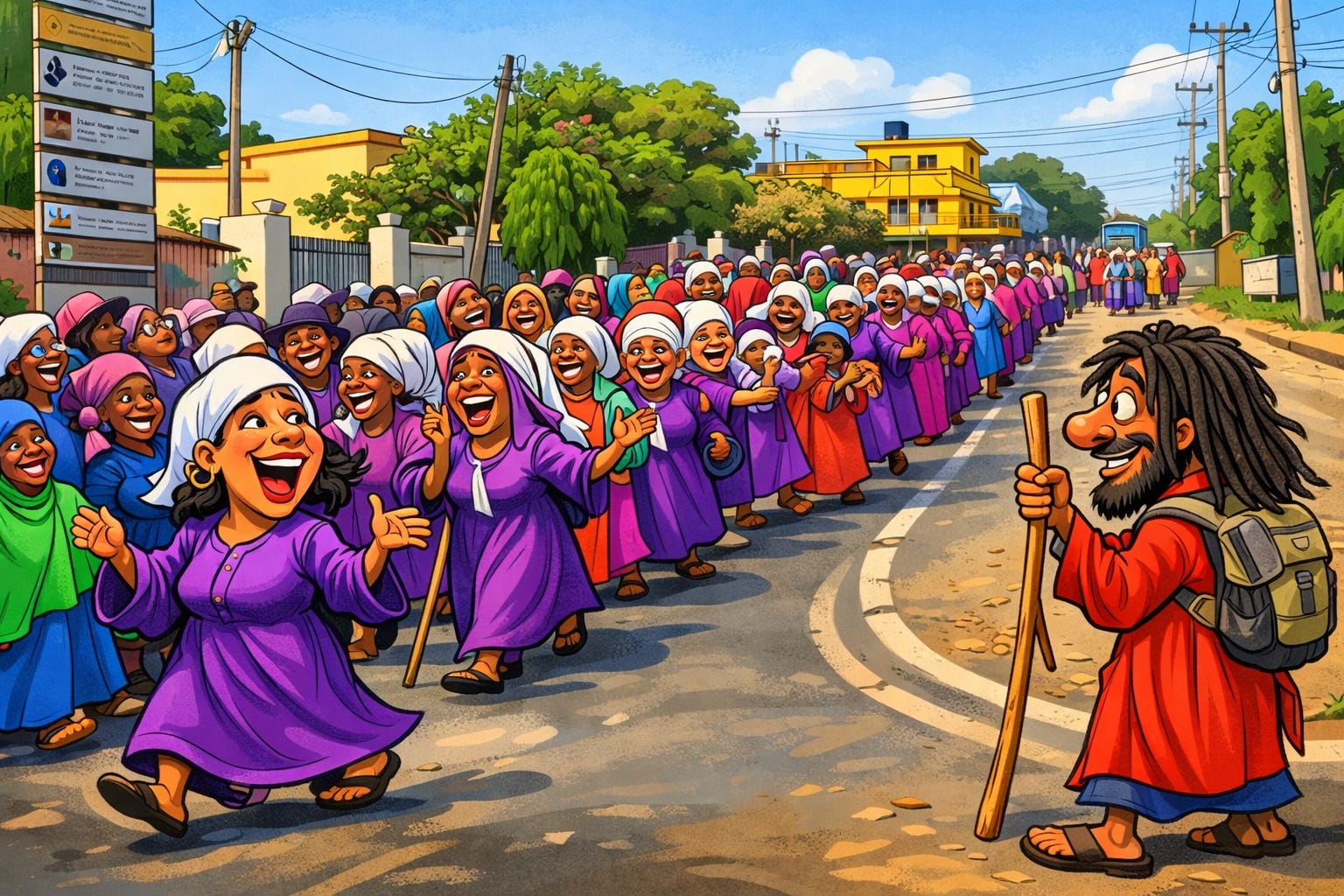
Among African Initiated Churches, Legio Maria stands apart — not because it was loud, but because it was brave.
It may be the only movement bold enough to break away from Roman Catholicism while retaining Latin liturgy, hierarchy, sacramental discipline, and ritual seriousness — and still assert an African theological imagination.
Founded in the early 1960s by Simeo Melkio Ondeto, revered by followers as the Black Messiah, alongside the mystic Mama Maria, Legio Maria did something radical.
They said:
Africa does not need a translated Christ.
Africa can encounter Christ as itself.
They kept the Mass structure, saints, fasting, processions — even a Pope. But sermons moved fluidly between Latin and Dholuo.
With millions of adherents, Legio Maria became proof that people don’t reject faith — they reject erasure.
Women, Purple, and Being Seen
There’s a detail many miss.
Legio Maria saw women.
In a patriarchal religious landscape where silence was often spiritualised, colour became calling. A woman in purple carried authority — not loud, not performative, but recognised.
Purple symbolised maturity, repentance, humility, and quiet leadership.
People don’t leave buildings when sermons fail.
They leave when they are no longer seen.
What Dashboards Don’t Tell You
Somewhere between hymn verses, my Kenyan brain did what it always does.
It went to work.
I sit in rooms with executives uneasy — not because business is collapsing, but because signals no longer align. Dashboards are green. Numbers look impressive. Yet something feels hollow.
Campaigns “perform” but nothing moves.
Followers grow
Revenue doesn’t.
If you want to know whether influence is real, check quietly (my own experience):
Who forwards your content privately. Who references it weeks later without tagging you. Who screenshots and asks, “Can we talk?” How often silence follows your post.
Influence rarely announces itself. The guys in the corner office sometimes are trained not to perform approval.
Attendance dropped before belief did.
Dashboards delay reality.
10,000 impressions doesn’t mean ten thousand people cared.
6 new subscribers may mean six decision-makers.
Faith metrics work the same way.
Rugby, Absence, and Relocation
International rugby is back — properly back.
Six Nations, Round One:
France 36 – Ireland 14
Italy 18 – Scotland 15
England 48 – Wales 7
Old systems. Old rivalries. Some maintaining, others declining.
Structure, depth, muscle memory.
Then the shorter version.
HSBC SVNS Perth:
Men: South Africa beat Fiji 21–19
Women: New Zealand beat Australia 29–7
HSBC SVNS Singapore:
Men: Fiji beat France
Women: New Zealand beat Australia 36–7
What stood out wasn’t just who won.
It was who was missing.
Kenya Corner — conspicuously absent.
Sometimes absence tells a deeper story than presence. People don’t stop caring. They stop recognising themselves.
The early warning sign isn’t noise.
It’s quiet relocation.
From Door Handles to Love Handles
China banned cars without visible door handles. India followed.
For over a decade, EV designers chased flush, hidden, pop-out handles — popularised by Tesla, copied everywhere. The logic was aerodynamics, aesthetics, marginal efficiency gains.
Then crashes happened.
In several incidents, power failure meant doors couldn’t open. First responders struggled. Seconds mattered.
China responded decisively.
From January 1, 2027, all passenger vehicles sold in China must have mechanical door releases — inside and outside. No reliance on electronics.
Why it matters: China sells over 25 million vehicles a year, including more than 7 million new-energy vehicles. Roughly 60% of top-selling EVs use hidden or flush handles.Millions of cars will now be redesigned back to visible handles.
Design chased beauty. Reality demanded grip.
That thought spiralled — as thoughts do — into love handles.
Those stubborn bits of flesh.
Immune to planks.
Resistant to Pilates.
Untouched by yoga.
Maybe love handles are back too. Just in time for Valentine’s.
Maybe some handles aren’t flaws.
They’re safety features.
Something to hold on to when life swerves.
Faith, Rugby, Marriage
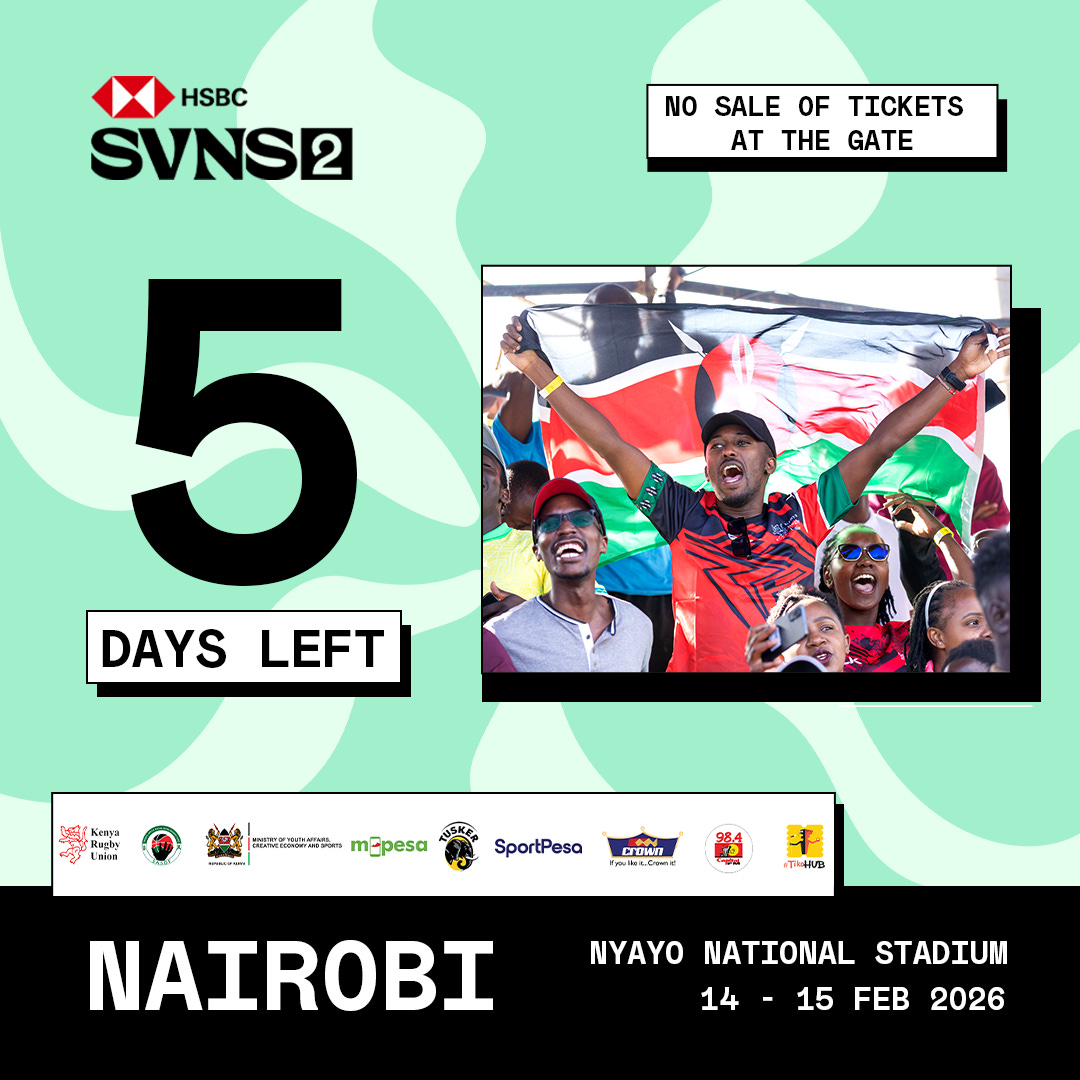
Which brings us to National Marriage Week. (7-14th Feb look it up)
Quiet. Heavy. Necessary.
There’s a rumour — still being traced — of a local pastor willing to perform 48-hour weddings during the HSBC SVNS Nairobi 7s. If confirmed, we may need to secure him accommodation in Nairobi West — because BnBs will be full.
We also hear that the event may be graced by The Archbishop of Naxbury, a reformed Marine, currently a Kenya Exile, gracing the occasion.
A truly world event.
Faith. Rugby. Marriage.
All colliding — not in a cathedral, but in culture.
People didn’t leave faith.
They left buildings that stopped listening.
Faith adapted. Influence moved. Community regrouped.
And somewhere between hymns, hashtags, scrums, dashboards, love handles, and late-night songs
belief quietly survived.
Same forest.
Different monkeys.
What hymn still lives in you?
What life metric are you overvaluing?
Where did your faith actually go — if it ever left?
Tukutane Nyayo
#KenyaCornerIsHome