
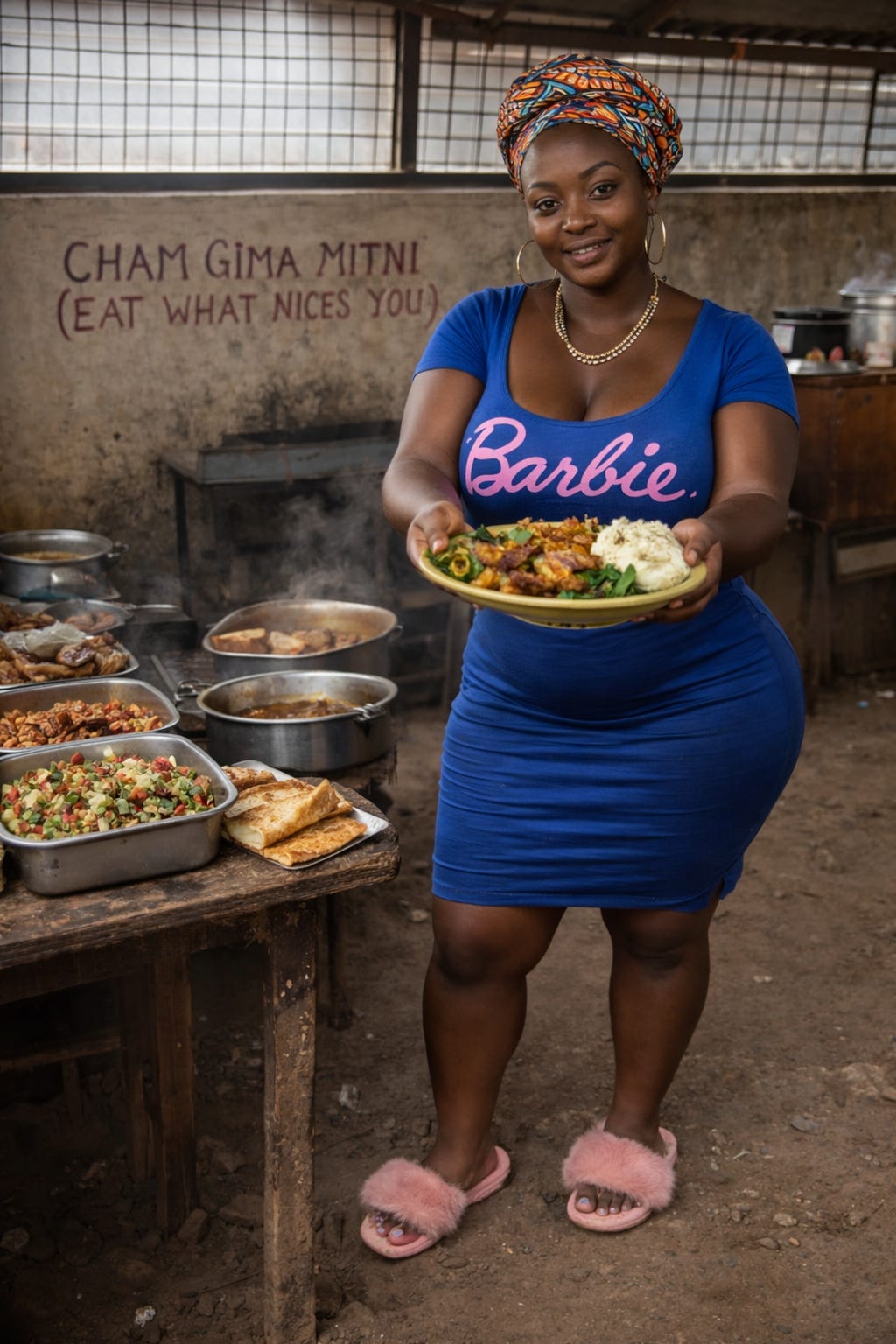
Our story begins the way many of my hare-brained schemes do.
Hungry. Unplanned. Slightly philosophical.
As a developing Sunday ritual, I visit Akinyi’s kibanda for brunch.
Choice meats.
Matumbo. Nyama boil. Omena.
And my personal weakness — tong mang’eny (many eggs), with sides of managu and an unapologetic ugali saucer.
This is Akinyi’s spot. Plastic chairs. Wooden benches. A low corrugated plastic roof that guarantees 32-degree heat all day. Odongo Swagg and Jakadongo blaring from a small Chinese portable speaker. On the wall, painted as an afterthought:
“Hatuna Wi-Fi.”
We don’t have Wi-Fi.
Kinyi has a wicked sense of humour.
Everyone is sweating.
Why is the sweetest food always served at steam-room temperature?
As I scan for a seat, my eyes land on what might be one of the most effective Calls to Action (CTA) I’ve seen in a long time, scribbled in fading paint on the wall.
You’re at a bus stop. A nganya slows down.
The conductor isn’t selling poetry. He’s selling direction.
“TOWN! 50! TOWN! Finje TOWN! Ya kuenda!”
That’s a Call To Action.
If you want to go to town, get in now.
Miss it — the matatu moves.
Back to the kibanda.
On the wall:
CHAM GIMA MORI
(Eat what pleases you)
Next to it:
CHAM GIMA MITNI
(Eat what nices you — kula ile roho inataka)
No agency.
No brand consultant.
No strategy deck.
Just truth.
The Positioning Problem the Untrained Eye Misses
There is just one problem. I call Akinyi over.
“Jaber,” I say.
“The message is behind the customer. You only read it after eating.
Which means it doesn’t persuade. It only reassures.”
A powerful message.Badly positioned.
The lecture pauses.
Akinyi, Barbie, and the Slippers
Akinyi is a full-bodied African beauty from the lake.
Dark. Confident. Current. Plugged into what’s trending.
She’s wearing a very tight cotton blue dress — slightly used — with Barbie emblazoned across the chest.
Global brand dominance. No marketing budget.
Then I see them.
The slippers.
Those fluffy pati-pati ones. Pinkish. Velvety. Furry like an overfed house cat.
About 300 bob online — retail therapy sweet spot. Buy without guilt.
Bedroom slippers that were never meant to see dust, but Kenya has promoted them to everyday wear.
No grip. No ambition.
No business near mud, charcoal, or omena oil.
I don’t hate them. Hate is strong.
I abhor them.
And yet — they are everywhere.
Supermarkets. Sidewalks. Stalls.
That’s when it clicks.
You can’t unsee them.

Those slippers didn’t become popular because they are practical.
They became popular because we see them.
Everywhere.
Anyone who has sold FMCG or alcohol knows the rule. Bamzigi, the van salesman, lived by it:
Eye level is buy level.
Modern language just dressed it up:
Attention economics. Scroll-stop power. Thumb-zone optimisation.
TikTok didn’t invent persuasion.
It moved the shelf.
Old shelf:
Fridge → middle row → eye level
New shelf:
Phone → feed → first three seconds
TikTok works because:
It puts products directly in the eye line
Repetition creates visual ownership
People buy before logic wakes up
Same psychology as slippers at a kibanda.
This is why:
Beer brands fight for middle-shelf fridge space
Supermarkets charge premiums for eye-level placement
TikTok works
TikTok is not magic.
TikTok is eye-level marketing.
Your product appears where attention already is.
Akinyi’s CTA works.
It’s just facing the wrong direction.
And suddenly I realise — this isn’t a kibanda problem.
It’s a global one.
Same forest.
Different positioning.
The Diet Stories We Never Question
Cham Gima Mitni sounds obvious at a kibanda.
But controversial the moment you leave one.
We live in a world where normal food needs defending, while madness gets rebranded as discipline.
Let’s talk about diets. Not food.
Diets.
The Mermaid Diet
This one came from WhatsApp. Shared by a mermaid. An actual mermaid.
No disclaimers. No irony. Just confidence.
Eat Matumbo and innards.Dump fruit. Keep the avocado. Use animal fat only.
That’s it.
The comments were instant chaos. Gout sufferers revolted. Doctors typed essays. Someone said “H**L NO.”
But here’s the thing — it spread.
Not because it was correct.
Because it was visible and delivered with conviction.
The 60-Day Fast
Then there’s the other one.
The 60-day fast.
It always arrives wearing spiritual robes.
Someone casually says, “Yeah, I did a 60-day fast.”
Not six days. Not intermittent.
Sixty.
The room goes quiet. Respect is silently awarded.
We clap for suffering if it looks intentional enough.
We celebrate self-denial when it wears a halo.
I’m not discouraging anyone. Lakini sometimes…
Back at the kibanda, nobody is pretending.
You’re hungry — you eat.
You want eggs — order tong mang’eny.
You want more ugali — you shout.
No guilt narrative.
No redemption arc.
Just: kula ile roho inataka.
And somehow, that feels more radical than fasting for sixty days.
AFRICA TOP ELEVEN: PLAYER VALUE REPRICING TABLE (AFCON EFFECT)
AFCON is not just football.
AFCON is a balance-sheet event.
For one month:
European clubs lose African players
Wages are still paid
Results wobble
Revenue risk rises
But something else happens quietly.
Valuations change.
AFCON is a compressed, high-pressure market discovery platform.
The Silicon Valley of football. Where every player has a 90-minute reel as an elevator pitch.
Players move from:
“Rotation option” → “Core asset” Imad, Oshimen
“£30m maybe” → “£60m minimum” Pape Gueye (the Senegal lefty)
Budgets approved six months earlier suddenly look stupid.
Boards don’t hate AFCON because of football.
They hate it because new information enters the market late.
That is the most dangerous thing in business.
AFCON functions as a compressed, high-pressure market discovery platform.
In 30 days, information asymmetry collapses, performance risk is repriced, and asset valuations adjust in real time.
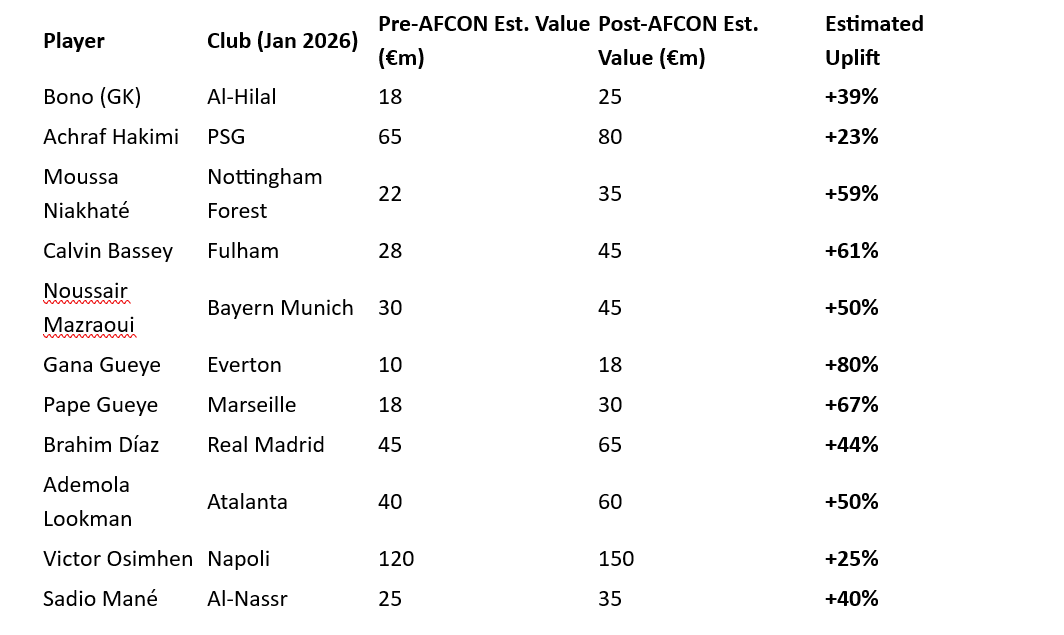
Africa XI – Valuation Impact Summary
Total pre-AFCON valuation: ~€421m
Total post-AFCON valuation: ~€588m
Net paper value created in ~30 days: ≈ €167m
Average uplift per player: ~40%
AFCON did not “entertain.”
It repriced assets.
Africa’s Youth Bulge and the Attention Economy
Africa is the youngest continent on earth. Median age: about 19.
In key markets — Kenya, Nigeria, Ghana, Ethiopia — Gen Z and young millennials dominate urban consumption now.
Bulge economies don’t behave like ageing ones.
They are:
Visual
Impulsive
Experience-driven
This explains:
Why TikTok beats television
Why fluffy slippers become mainstream overnight
Why Mermaid Diets travel faster than peer-reviewed nutrition
Why AFCON commands billions of eyeballs without apology
African consumer behaviour is no longer niche.
It’s leading.
Cham Gima Mitni as Philosophy
Cham Gima Mitni is not laziness.
It is not indulgence.
It is not recklessness.
It is alignment.
Bulge economies don’t respond to discipline narratives.
They respond to visibility and resonance.
That’s the thread beneath:
The kibanda wall
The slippers
The diets
AFCON
Rugby at Nyayo
Demography is destiny.
But visibility decides who gets paid.
The Warm-Down
AFCON reprices talent.
The EPL manages incentives.
But rugby? Rugby does not hide. Rugby shows up.
Fast. Violent. Joyful.
At eye level.
This Valentine’s weekend:
Cham gima mitni.
Eat what pleases you. Watch what excites you. Show up for what moves you.
🏉 HSBC Rugby 7s- Valentine’s Weekend 2026
📍 Nyayo Stadium
🎟️ https://tikohub.com/events/404/Landport
Bring your person.
Bring your kids.
Bring your appetite.
Same Forest.
Different Monkeys.
Super!! Well written once again.
Made my afty. Haven't read something that witty in a while!