

The first time I saw HeHa Movers, I thought someone had assembled a Kenyan version of the Wu-Tang Clan. I almost expected a beat to drop, followed by a new song and a new rhyme.
Straight out of thug life.
Uptown kids in the 90s had names for guys who looked like this: Oboho. Mgondi.
The new-age cool kid might say Wasee. Madingo.
These ones answered to something else.
HeHa
/ˈheɪ hɑː-hɑː-hɑː/
pronounced: He (hay) + Ha (ha-ha-ha)
noun
Kenya’s favourite movers; a fearsome-looking crew trusted with your furniture, house keys and, apparently, your entire life.
verb (informal, Kenyan)
To move, remove or relocate something—or someone—whose time has come.
Example: All Blacks walijenga Heha mission ya Springboks
(Yesterday the All Blacks sent HeHa Movers the Springboks’ hotel address.)
Tuachie keys. (leave the keys with us)
These were the guys you imagined meeting in a dark corner and quietly surrendering your wallet before anybody asked.
In 2026, the transaction would be more sophisticated.
Wallet. Mobile phone. Password. M-Pesa PIN. Voter’s card.
Except HeHa were not coming for your money.
They were coming for your furniture.
No international affiliation. No stickers pronouncing FRAGILE. You handed them the keys and went to work. By evening, your entire life had moved house. Beds assembled. Television connected. Perhaps even the milk transferred from the old fridge into the new one.
Then the internet took over.

Soon HeHa were moving relationships, tenants, politicians and football teams. After Manchester United lost, somebody dressed them in Hull City colours. Nobody needed an explainer. The movers had arrived.
HeHa now meant the discussion was over. Negotiation had failed.
Somebody had stayed beyond checkout time.
Like it or not, something had to move.
Some saw harmless Kenyan creativity. Others saw the comic normalisation of goonism. Today they remove your sofa. In August 2027 the meme places them outside Parliament.
Maybe that asks too much of a joke. Kenyans have always used humour to domesticate what frightens us.
For marketers, HeHa is the dream and nightmare arriving in the same truck.
Companies spend millions trying to enter ordinary banter. Agencies are hired. Strategy retreats are held. Twelve versions of one hashtag travel around the building awaiting approval. HeHa showed up with stern faces and three words.
Kenya’s netizens handled the distribution.
Then people began changing the product without permission. Once customers start finishing the joke, the brand belongs to whoever creates the next meme. HeHa may have wanted to move households.
Kenya appointed them official movers of anything whose time had expired.
Toyota knows something about entering ordinary speech.
“The car in front is a Toyota.”
That advertising line sounded as though it had been written after an afternoon in Nairobi traffic. Look ahead: Corolla, Probox, Vitz, Fielder, Hiace or Land Cruiser. Look behind and there was probably another one flashing its lights.

By 2018, Toyota reportedly accounted for nearly 60 per cent of Kenya’s new and used vehicle sales. Of the 62,495 used vehicles imported during the 12 months to June 2023, 58,972—94.3 per cent—came from Japan.
Now something inside some of those cars must move.
CFAO Mobility Kenya says certain Toyotas manufactured between 2001 and 2017 may contain defective Takata airbag inflators. Heat and humidity can degrade the propellant. If the airbag deploys, the inflator may rupture and fire metal fragments into the cabin.
Yes. The airbag.
More than 100 million Takata inflators involving over 20 manufacturers have been recalled worldwide. It became the largest automotive recall in history. CFAO is inspecting affected Kenyan vehicles and replacing the airbags free of charge. What it has not publicly disclosed is how many are on our roads.
That’s the real question.
A vehicle sold new in Japan may arrive in Mombasa, change owners twice and become somebody’s faithful runaround in Nyeri, Migori or Kitengela. Toyota may still have the chassis number. The name beside it could belong to somebody who has not seen that car since Obama’s first term.
The warning that reached me came through an insurance company. CFAO presented the campaign to the Association of Kenya Insurers. AKI then asked insurers to alert affected customers and help CFAO reach the people currently driving the vehicles, subject to data-protection safeguards.
Toyota may know the car. The insurer may know where it sleeps tonight.
Owners of Toyotas manufactured between 2001 and 2017 should check the chassis or vehicle identification number with CFAO. Inspection and replacement are free.
HeHa made handing over your keys sound like a joke. This time, hand them to the people authorised to remove something that should not remain inside your car.
Then take them back.

Somewhere between Tinder’s swipe right and the church elder’s wait upon the Lord, somebody created Adventist Dating. https://adventistdating.com
The algorithm has already removed smokers, Saturday workers and those who believe Friday evening is when the weekend should begin noisily.
Doctrine is handled before hobbies, height or whether the potential soulmate owns a pressure cooker.
A 2026 SSRS survey found that 37 per cent of American adults had used a dating site or app. People are there because the apps sometimes work. They are also there because meeting somebody after a certain age is no longer as simple as looking interesting at a wedding and waiting for a persistent auntie.
Faith narrows the search. It does not remove filters, subscription plans, ghosting or the married person whose profile says “complicated.”
Character development—also known as heartbreak—can still arrive wearing appropriate church clothes.
Nor are all the people returning to this market young.

Since 1990, the divorce rate among adults over 50 has doubled. Among those over 65, it has tripled. Researchers call it grey divorce.
Sometimes there is no explosive argument. No flying plates. No relative arriving at midnight to conduct emergency diplomacy. Just a slow drift that becomes visible after the children leave. Financial independence makes departure possible. The stigma is weaker. People are also living long enough to calculate how many years may still be left.
At 50, another 20 years is not a footnote.
Dating after 50 used to be quiet(or so I’m told). A subtle inquiry at Bible study. Perhaps golf. A chance meeting at a wedding, followed by discreet enquiries about “that gentleman who was sitting with the cousins.”
Not anymore.
Now there are profiles, brutal age filters and demands for a recent photograph because the one beside the waterfall appears to have been taken during Mwai Kibaki’s “Tosha” rally.
The easy interpretation is that Gen X and the boomers are ageing disgracefully. Maybe. Twenty years is still a long time to remain where affection, conversation or respect have left the room.
So older people are moving. Out of marriages. Into smaller houses. Onto dating apps. Occasionally back to church after discovering that OnlyFans has its own version of spiritual deliverance.
And while HeHa may transport the sofa, something moved at Ellis Park on Saturday.
THE CENTURION’S CURSE
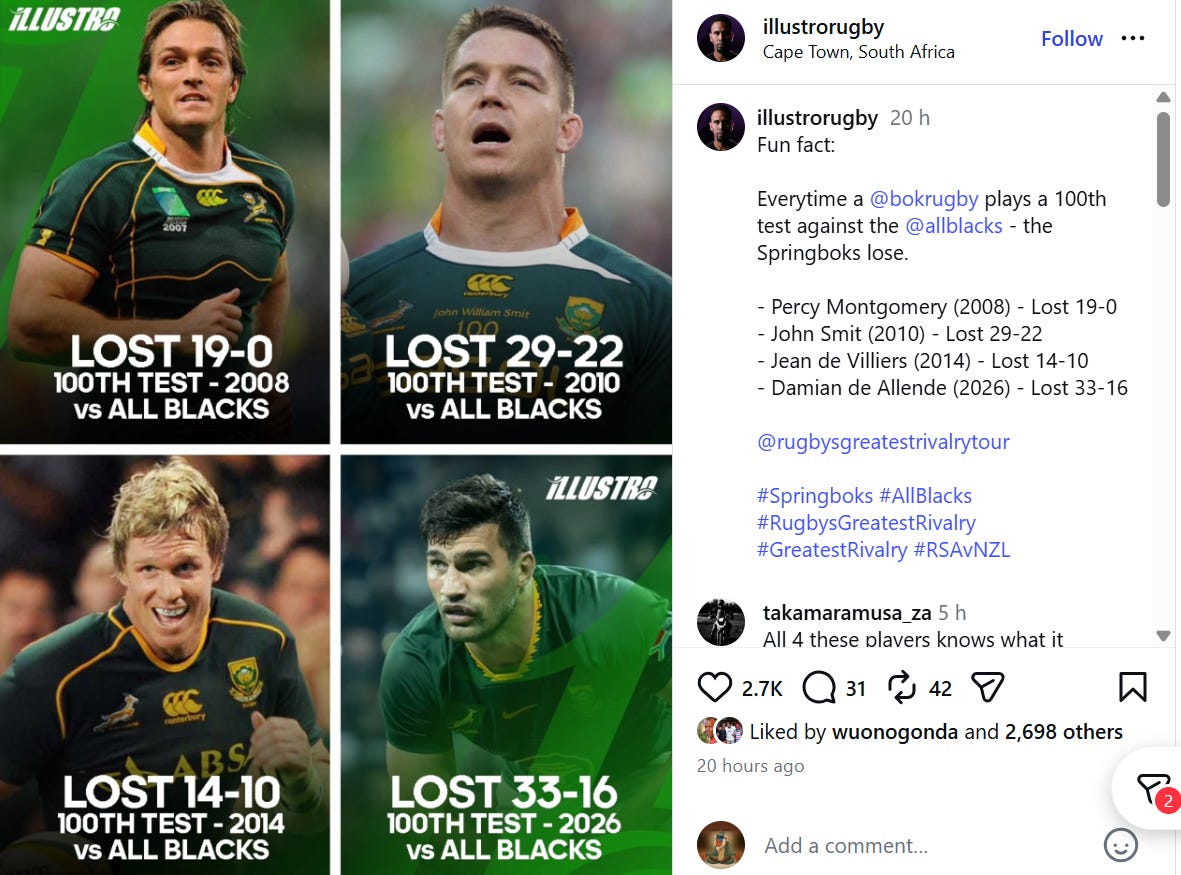
The Springboks entered as back-to-back world champions and favourites. Home ground. Early scrum dominance. South Africa led 13–12 at halftime, then 16–12.
New Zealand went home 33–16 winners.
Five tries to one. South Africa’s 12-match winning streak was over.
It was Damian de Allende’s 100th Test. He became the fourth Springbok to reach that milestone against the All Blacks—and the fourth to lose.
Percy Montgomery, John Smit and Jean de Villiers had already discovered that address.
Same Forest. Different Springboks.
If you have sat through a Monday morning pipeline meeting, you know this match. One company has the larger sales force, famous brand and 1,000 leads in the CRM. Everybody reports plenty of activity. The smaller competitor finds an opening and takes the business.
Territory does not pay salaries. Neither do 1,000 unclosed leads.
This week, everybody moved something: furniture, dangerous airbags, relationships and five rugby balls across the try line.
Not all movement is progress. Sometimes we change houses and carry the same disorder with us.
We stay busy—very busy—and call it momentum.
The scoreboard tells the real story.
Have a mobile week.
Keep moving. Keep selling. Keep becoming.
Msitu ni ule ule. Nyani wale wale. (Same Forest. Different Monkeys.)
Mubarikiwe. Jah Bless.
Go with song. (A real banger from the 90s)
I love this.